What is "Tantalizing"
about the "Gap"
in Kant’s Philosophical System?
Prof. Stephen
Palmquist, D.Phil. (Oxon)
Department of Religion
and Philosophy
Hong Kong Baptist
University
I
am as it were mentally paralyzed even though physically I am reasonably well. I
see before me the unpaid bill of my uncompleted philosophy, even while I am
aware that philosophy, both as regards its means and its ends, is capable of
completion. It is a pain like that of Tantalus though not a hopeless pain. The
project on which I am now working concerns the "Transition from the
metaphysical foundations of natural science to physics." It must be
completed, or else a gap will remain in the critical philosophy. Reason will
not give up her demands for this ... [KPC
251][1]
I. The "Gap" and
the "Transition": Förster's New Interpretation
In
this famous passage from a 1798 letter to Christian Garve, Kant confesses that
he sees a tantalizing "gap" in his philosophical System, a gap
connected in some way with the "Transition" project he was then
working on, as contained in what we now call Kant's Opus Postumum (OP).
Interpreters have typically assumed that the "gap" and the
"Transition" refer ßto exactly the same thing, namely, to the book
Kant hoped OP would become. As a
result, there has been a long-standing, twofold conundrum concerning Kant's
intentions in OP. First, Kant clearly
states in his Critique of Judgment (CJ) that with this book (published in
1790) he brings his "entire critical undertaking to a close" [CJ 170], so how can a new gap suddenly
appear eight years later? And second, Kant's Metaphysical Foundations of Natural Science (MFNS) had already accomplished, in 1786, something like a
transition between the Critical System and physics, so why does there need to
be another transition between this
first transition and physics? These twin problems have led some scholars to
suppose that, when Kant mentions mental paralysis in his letter to Garve, he is
actually referring to the onset of senility, and that this affliction
eventually caused the sage of Königsberg to waste the last years of his life
writing nonsense.
Eckart
Förster has recently proposed an interesting new alternative explanation which,
he argues, could provide some much-needed clues for drawing together the
diverse pieces of this puzzle.[2]?/span>He argues that
Kant must not have intended the words "gap" and
"Transition" to refer to the same thing, because the idea for writing
a Transition can be traced "back at least to the year 1790" [536],
yet no mention of a gap is ever made until September of 1798 [537]. He thinks
this indicates that something must have "happened in 1798 which prompted
Kant to reflect anew on his philosophy, and which brought to his attention a
gap in the critical system that had previously escaped him" [537]. Förster
conjectures on the basis of an ingenious compilation of evidence that the event
in question, which sparked Kant's recognition of the gap, was the publication
of a Prize Essay question by the Berlin Academy of Sciences, criticizing Kant's
view of mathematics and favoring "the general empirical origin of all our
cognitions" [quoted in GAP 554].
This event, suggests Förster, may have "led Kant to reflect anew on the
role of mathematics in philosophy and hence, ultimately, to revise his position
substantially" [555]. Although he does not claim to have presented a
thorough analysis, Förster points out that the theory of the role of mathematics
in physics which Kant develops in OP
appears to be contrary to the official "Critical" position [GAP 549-552]. This difference, Förster
claims, suggests that the word "gap" refers to Kant's sudden, painful
realization that "the question of the objective reality of [the first Critique's] concepts and principles
still awaited a satisfactory demonstration" [GAP 551]—a question that would therefore need to be answered in OP as part of the Transition.
Förster
defends his position by noting that OP
contains a "polemic against mathematical foundations" [GAP 550] that seems to contradict
directly the view presented in MFNS, where mathematics is regarded
as the necessary link between metaphysics and physics: "A pure philosophy
of nature in general", Kant explains, "may indeed be possible without
mathematics; but a pure doctrine of nature concerning determinate natural
things ... is possible only by means of mathematics" [MFNS 470]. If in OP
"mathematics is expelled from the philosophia
naturalis", then, Förster concludes, "the very possibility of a
‘pure doctrine of nature ...' is now in question" [GAP 550]. Thus the new gap that Kant supposedly recognized suddenly
in September of 1798 was that the function of MFNS (see below) must now be replaced by a non-mathematical defense of the objective reality (i.e.,
applicability to physics) of the categories and principles defended in CPR.
Förster's
new alternative, then, is that "Transition" refers to the book that
was to be composed out of the notes contained in OP, whereas "gap" refers to the recognition while writing
this book that his former "Critical" view of mathematics (as
developed in MFNS) was mistaken and
therefore needed to be replaced. Unfortunately, Förster has overlooked several
problems that render his novel explanation untenable. After uncovering these
problems, I shall demonstrate how they can be resolved by means of an
alternative interpretation of the terms "gap" and
"Transition".
The
first problem raised by Förster's conjecture is that it seems rather far-fetched
to suppose that the person who is arguably the most influential philosopher in
modern times, and who showed such extreme (often annoying) confidence in the
validity of his work, would suddenly revise one of the most basic tenets of his
(by then) well-established System, just because someone saw fit to question it. This would not be the
recognition of a gap, but a
revolutionary rejection of an
important part of the Critical enterprise, in favor of something closer to
traditional empiricism. Moreover, such an interpretation fails to explain why
Kant would say repeatedly in OP that
this book adopts the "highest standpoint of transcendental
philosophy" [e.g., OP 23,32]. If
OP is intended to revise such basic
Critical doctrines as the role of mathematics in physics, then it would hardly
seem appropriate for Kant to call it the highest
standpoint of his System, but, at best, a revision of the standpoint formerly adopted erroneously! Yet, as I
shall argue shortly, no such problematic revision need be supposed, once the
thoroughly perspectival structure of
Kant's philosophical System is taken into account. The views expressed in OP are in no sense intended to replace
the views expressed in any of the three Critiques,
but instead are intended to answer some of the same questions from a different
standpoint. Solving this first problem, then, will require an explanation of
how the apparently contradictory theories Kant proposes in MFNS and OP can be
rendered compatible.
The second
problem arises when Förster [in GAP
538] denies the traditional view of MFNS,
whereby it is regarded as a partial fulfillment of Kant's plan to write a Metaphysics of Nature.[3]?/span>Förster rightly
recognizes that MFNS is "Kant's
philosophy of physics, or, rather, of physics' rational part" [GAP 544]; however, he believes its
function in Kant's System should be understood in connection not with the
proposed Metaphysics of Nature, but
with CPR, as a kind of extended
footnote to the Schematism: "Since the Schematism chapter dealt
exclusively with time-determinations and inner sense, it did not specify the
‘sufficient' conditions of the application of the categories; it required
supplementation by a work that laid out the form and principles of outer intuition in their entirety"
[GAP 542]. MFNS can thus serve "to supplement the Schematism and to
complete the proof of the objective reality of the categories" [GAP 543]. In fact, Förster goes so far
as to conclude from certain comments in Kant's Preface [MFNS 477-478] that MFNS
is not intended to be "part of the metaphysical system" at all [GAP 538-539]. He infers this from the
fact that Kant uses a rather unfortunate metaphor in describing the relation
between MFNS and "general
metaphysics ... (properly, transcendental philosophy)" [MFNS 478]: Kant says MFNS is like "a shoot springing
indeed from [the] root [of general metaphysics] but only hindering its regular
growth"; hence in MFNS Kant
"plants this shoot apart ... [from] general metaphysics."
The
second problem is that there are at least five weighty objections to this
aspect of Förster's interpretation. First, if MFNS served such a key role in the completion of the first Critique, then Kant would certainly have
made a point of stressing this fact at some point in the second edition
(published one year after MFNS); yet
the second edition makes no reference to MFNS.
Second, he would probably also have included these crucial new arguments
themselves in the second edition (at least in summary form), since without them
the arguments in the Critique are
supposedly "insufficient"; yet no such arguments numbered among the
many revisions Kant made to CPR in
1787. Third, the analogy of the "shoot" being entirely separable from
the original plant, so that each can survive independently, would be wholly
inappropriate if Förster's position is correct. Instead of emphasizing the sufficiency of CPR to stand on its own, as Kant intended, just the opposite would
be true: the mother plant's roots (CPR)
would not be able to survive once the shoot (MFNS) were transplanted. Fourth, Förster's accurate recognition of
the need for a "completion" of the Schematism, with its exclusive
emphasis on time, is misplaced. For
he neglects the fact that this need is actually satisfied in the very next
chapter of CPR, the Principles of
Pure Understanding (and especially in the second edition Refutation of
Idealism), where space is
reintroduced into the system of knowledge, and its formal characteristics
defined. Finally, in MFNS Kant
clearly portrays his purpose as being, much like the purpose of his later Metaphysics of Morals (MM), not to provide a formal completion of CPR, but to provide material for its proper application—i.e., "instances (cases in concreto) to realize the concepts and
propositions of [CPR]" [MFNS 478]. And this is not the task of Critique, but of Critically enlightened metaphysics.
The
mistaken character of Förster's interpretation of Kant's analogy of the
"shoot" is made more obvious when we read MFNS 477-478, where Kant says MFNS's
separation from the rest of the System can be done "without mistaking its
origination from metaphysics or ignoring its entire outgrowth from the system
of general metaphysics. Doing this does not affect the completeness of the
system of general metaphysics" because this "separate metaphysics of
corporeal nature" is now to be viewed as a smaller part (i.e., a subsystem) within "the larger system of metaphysics in
general". Kant's point, in other words, is simply that, in keeping with
his usual systematic method, he will divide his subject-matter into different
"standpoints", and deal with each separately. The word
"separately" here does not imply a complete detachment from his overall System, but simply a strategy of
"divide and conquer".[4]?/span>Kant is saying
that, instead of mixing together topics that adopt different standpoints, he
prefers to treat them separately, with the understanding that they all remain
under the "umbrella" of the general Perspective of the System (i.e.,
the Copernican Perspective, as described in the Preface to the second edition
of CPR). Of course, this second
problem gives rise to the need to determine more accurately the precise nature
of the relationship Kant saw between MFNS
and the rest of his System—a task I shall attempt to fulfill later in this
essay.
In
addition to the problems associated with Förster's assumption that Kant would
decide to make a fundamental revision
of his entire System at such a late stage in his life, and with his assumption
that MFNS fills a gaping hole in CPR's Schematism, a third problem now
rears its ugly head: namely, Förster accepts the traditional view that Kant's
overall purpose in OP was to
construct his infamous "Transition". Because Kant says in his letter
to Garve that his current project "concerns
the ‘Transition from the metaphysical foundations of natural science to physics'", commentators have almost
universally assumed he intended this, or something like it, to be the title of that work [see e.g., P8 281n]. But this completely ignores
the fact that a significant portion of OP
(e.g., most of fascicles one and seven) is concerned not with physics and theoretical reason but with theology and
practical reason. It also ignores the
fact that the first fascicle contains quite a few notes that are obviously
ideas for prospective titles, presumably either for major divisions or for the
work as a whole. "Transition ..." is only one of many titles that
appear here, and was probably intended to apply to only one of the twelve
divisions of OP (perhaps the twelfth
[see OP 22.543]), since it does not aptly reflect the book's overall
content. Indeed, even a cursory reading of OP
reveals that Kant's interests were much broader than simply to establish such a
Transition. This third problem, then, gives rise to the need to describe more
fully the true purpose of OP.
A
fourth and final problem with Förster's interpretation is that it fails to give
an adequate explanation for why Kant would describe the gap in his System as
giving rise to "a pain like that of Tantalus". If the gap is really
the recognition that his previous view of the relation between mathematics and
physics is wrong, then this gap would not be tantalizing, but sickening, especially for someone who
had devoted so much time and energy to the task of developing a System that
rests (at least in part) on what would now be seen to be an incorrect view. The
whole tenor of Kant's remarks to Garve suggests that the gap in question is
tantalizing because it would complete the System for the first time, not because it would revise a System he had formerly thought to be complete. Providing
an alternative interpretation that avoids this final problem will therefore
require a more direct explanation of the implications of Kant's allusion to the
myth of Tantalus.[5]
In the
remainder of this paper I shall offer another new explanation of the facts—one
that enjoys the benefits of Förster's helpful suggestions, but provides
solutions to the four problems raised above. I shall begin this task in the
next section by examining some of Kant's long-term motivations for constructing
a philosophical System; this will provide an important background against which
the issues we are considering can be accurately viewed. §III will then provide
a general overview of the architectonic relationships between the different
books that constitute this System, including a new explanation of what Kant was
aiming to accomplish in OP, thus
solving the first three problems raised above. Finally, I shall demonstrate in
§IV how this way of explaining the role of OP
provides a perfect solution to the fourth problem, by revealing the
significance of Kant's reference to the myth of Tantalus.
II. Kant's Critical Dreams as the Motive for a Philosophical
System
The
word "tantalizing" may seem oddly out of place in a discussion of
Kant's writing, so much of which is characterized by his often dry and abstract
style of reasoning. This is true, at least, until we turn our attention to what
is probably the most unjustly neglected work in Kant's corpus, his essay on Swedenborg's mystical experiences, entitled Dreams of a Spirit-Seer, Illustrated by
Dreams of Metaphysics (DSS)—the
work in which Kant compares the dangers of fanatical mysticism to those of
speculative metaphysics. For its dual emphasis on the hope for mystical
experiences and metaphysical knowledge of spirits, together with its
paradoxical and sometimes shocking insistence that such hopes are bound to be
disappointed, makes DSS one of the
only books Kant wrote that can legitimately be said to tantalize the reader. Moreover, this same book gives us a glimpse
of Kant's dawning awareness of a new, "Critical" way of doing
philosophy. Inasmuch as DSS sets out
for the first time a general problem that Kant devoted the rest of his life to
solving, it can be regarded as the "seed" that eventually sprouted
and grew into the "tree" of Critical philosophy.
Although
DSS is often interpreted as evidence
of a radically "empiricist" stage in Kant's development, supposedly
constituting a kind of Humean position, a careful examination of its contents
reveals that his true intention is already to encourage a Critical attitude (though he did not yet call it by this name).
While he comes down hard on the misuse of sensation and reason by spirit-seers
and metaphysicians, respectively, when they regard their "dreams" as
a source of knowledge [see S1 146], he clearly expresses his own dream that a properly balanced
approach to both mysticism and metaphysics would someday emerge. As we shall
see, Kant's Critical philosophy can be regarded as an attempt to construct a
secure foundation for such an approach. Although the "tree" had matured
by 1790, its "fruit" did not begin to ripen until shortly before
1798. For, as I shall argue in §III, OP
was to be Kant's attempt to complete at long last the cycle that began with DSS, by bringing to full fruition the
twofold task of Critical philosophizing. A brief overview of the contents of DSS will enable us to see more clearly
what this fruit actually is.
Before
beginning his examination of the similarities between fanatical mysticism and
speculative metaphysics, Kant hints at the Critical nature of the inquiry that
is to follow, by asking two opposing questions, but offering a "third
way" out. In the Preface to DSS
he asks "Shall [the philosopher] wholly deny the truth of all the
apparitions [eye-witnesses] tell about?" or "Shall he, on the other
hand, admit even one of these stories?" In response, Kant advises
philosophers to "hold on to the useful"
[DSS 317-318(38)], thus avoiding both
extremes. He then divides the main text into seven chapters, with the first
four constituting the "Dogmatic" Part and the last three constituting
the "Historical" Part. The correspondence between this division and
the Critical philosophy he was soon to begin constructing in his mind is
evident from the fact that Part One ends with a chapter on "Theoretical
Conclusions", while Part Two ends with a corresponding chapter on
"Practical Conclusions" [DSS
348(85),368(115)], thus foreshadowing, however dimly, the division between the
first and second Critiques.
Without
going into the detailed arguments of these seven chapters at this point [but
see P3 360-369], we can take note of
some of the ways in which they adopt or prefigure views later defended in
Kant's Critical philosophy. The first chapter of Part One begins with a
discussion of what a spirit is or
might be, and eventually appeals to freedom
as the key determining principle [DDS
327n(52-53n)]: "Whatever in the world contains a principle of life, seems
to be of immaterial nature. For all life rests on the inner capacity to
determine one's self by one's own will power." The question of the possibility of spirits is also answered
in an entirely Critical way: "The possibility of the existence of
immaterial beings can ... be supposed without fear of its being disproved, but
also without hope of proving it by reason"
[323(48-49), emphasis added]. Kant's negative remarks about those such as
Swedenborg, who actually claim to perceive
spirits, are well known. What is not so well known is that Kant does not, in
fact, go to the skeptical extreme that is typically attributed to him. Instead,
he cautiously admits in Chapter Two that in an apparition, "delusion is
mingled with truth", so that it tends to deceive a person "in spite
of the fact that such chimeras may be
based upon a true spiritual influence" [340(71-72), emphasis added].
Moreover, he develops in Chapter Two a complex theory of spiritual beings that
focuses on the moral character of all
spiritual reality: he argues that "the community of all thinking
beings" is governed by "a moral
unity, and a systematic constitution according to spiritual laws."
Thus, "because the morality of an action concerns the inner state of the
spirit", its effect can be fully realized not in the empirical world, but
"only in the immediate communion of spirits" [336(65)]. There is no
hint of skepticism here!
In
truly Critical fashion, however, Kant proceeds in Chapter Three to present what
he calls an "Antikabala"—i.e., "A fragment of common philosophy
aiming to abolish communion with the spirit-world" [DSS 342(74)]. Here he "renders entirely superfluous the deep
conjectures of the preceding chapter" [347(82)] by demonstrating that the
same experiences and knowledge-claims can be explained without making reference
to anything beyond the empirical world. This skeptical chapter also contains
Kant's harshest ridicule of those dogmatists who, like Swedenborg and like Kant himself just a few pages earlier,
have been smitten with the "disease" [e.g., 340(71)] of seeing
mystical or metaphysical visions. What is rarely acknowledged is that the
fourth and final chapter of Part One takes a step back from the conflicting
views defended in Chapters Two and Three, and seeks a balanced position between the foregoing dogmatic and
skeptical perspectives. In other words, Kant never intended his words of
skeptical ridicule to be taken as representing his true position. For he now
requests us to check "the partiality of the scales of reason" by
letting "the merchandise and the weights exchange pans"
[348-349(85)]. By this he means first, that we must give up all former
prejudices, whether skeptical or dogmatic [see 349(85-86)], and second, that if
we do, we will discover that "[t]he scale of reason is not quite
impartial", for it favors the pan "bearing the inscription ‘Hope for
the Future'" [349(86)]. In other
words, just as the Critical philosophy remains disjointed and incomplete until
the first two Critiques are
"crowned" by the third [cf. CJ
170]—i.e., by the Critique
corresponding to the question, "What may I hope? [see e.g., CPR 833]—so
also at this relatively early stage in his career, Kant had already come to
recognize that "even those light reasons [of hope] ... outweigh the speculations of greater
weight on the other side" [DSS
349(86); cf. CPR 617,795,811].
"This is the only inaccuracy [of the scales of reason] which I cannot
easily remove, and which, in fact, I never want to remove" [DSS 349-350(86)]. Far from concluding on
a note of skepticism, Chapter Four insists that, even though "in the scale
of speculation they seem to consist of nothing but air", the dreams of
spirit-seers (and metaphysicians)
"have appreciable weight only in the scale of hope" [350(86-87)].
Part
Two begins with a chapter that recounts three stories concerning Swedenborg's
spiritual powers. The next chapter then summarizes Swedenborg's own explanation
of his "ecstatic journey through the world of spirits" [DSS 357(98)]; here Kant emphasizes that,
in spite of being "utterly empty of the last drop of reason", the
ideas of his "hero" have a striking resemblance to "the
philosophical creation of my own brain" [359-360(101)]—i.e., to the theory
of spirits proposed in Chapter Two, as Kant's own, independently-constructed
position. He apologizes for wasting the reader's time, confesses he is still "in
love" with metaphysics, and insists that metaphysics as a rational inquiry
"into the hidden qualities of things" (i.e., speculative metaphysics) must be carefully distinguished from
"metaphysics [as] the science of the boundaries of human reason"
(i.e., metaphysics as Critique). This
distinction then becomes the focus of the "practical conclusion"
given in the third chapter of Part Two.
In
this final chapter of DSS, any doubt
about the Critical (as opposed to
dogmatic or skeptical) character of this treatise is resoundly dispelled. For
example, after distinguishing between what we can know for science and
what we need to know for wisdom, Kant emphasizes the importance
of determining what is impossible to
know, so that "the limits set to human reason by nature" can be
recognized, in such a way that "even metaphysics will become ... the
companion of wisdom" [DSS
368(115-116)]. In order to accomplish this task, he says, a new kind of
philosophy is necessary: once philosophy "judges its own proceedings, and
... knows not only objects, but their relation to man's reason, then ... the
boundary stones [will be] laid which in future never allow investigation to
wander beyond its proper district" [368-369(116)]. The fact that the
proper drawing of this boundary will exclude knowledge of spirits need cause no
concern to either mystics or metaphysicians, as long as we recognize that
"such knowledge is dispensable and unnecessary", because reason does
not need to know such things
[372(120)]: for "true wisdom is the companion of simplicity, and as, with
the latter, the heart rules the understanding, it generally renders unnecessary
the great preparations of scholars, and its aims do not need such means as can
never be at the command of all men."
Such
comments make it abundantly clear that DSS
served as a catalyst prodding Kant to set out a complete System of Critical
philosophy. Indeed, a proper understanding of DSS, as forming a vital part of the Critical philosophy's
historical context, is necessary for anyone who wishes to understand the
general purpose of Kant's System, and so also, to interpret properly the
purpose of OP. For if we keep in mind
Kant's foundational comparison between the sensation-dreams of those who claim
to have mystical experiences and the reason-dreams of those who claim to have
metaphysical knowledge, then the fact that Kant saw DSS as requiring him not to give
up his love of metaphysics, but rather to reform it (by applying to it the Critical method he was gradually
coming to recognize), clearly implies that he also hoped for the day when the
same Critical reform could be applied to the claims of mystics. In other words,
the connection between mysticism and metaphysics represents not just a passing
phase in Kant's early development, but an undercurrent that can be seen
operating throughout his entire System. For if no other message comes through
the pages of DSS, the notion that
Kant saw the possibility of mystical experience and of metaphysical knowledge
as standing or falling together, as
two sides of the same coin, shines forth like the noonday sun.
III. The Opus Postumum as the "Grand
Synthesis" of Kant's System
Keeping
in mind the foregoing account of one of Kant's most significant background
motivations for constructing a philosophical System, we can now return to the
problems introduced in §I, in hopes of finding a fresh solution to each.
Solving the third problem, concerning the true role of OP in Kant's System, is one of the main concerns of the present
essay. But any solution to that problem depends on how one solves the second
problem, concerning the precise relationship between MFNS and Kant's other systematic works. I shall therefore begin by
attempting to solve this second problem, pass from there to a consideration of
the third and central problem, and conclude this section by considering the
first problem, concerning the apparent change in Kant's view of mathematics in OP, versus that in MFNS. Solving the fourth problem, concerning the full significance
of Kant's reference to the myth of Tantalus, will then be the task of the
fourth and final section of this paper.
In CPR 869 Kant explains that a complete
system of metaphysics must include a speculative (i.e., theoretical) and a
practical subsystem. He calls the former "metaphysics of nature" and
the latter "metaphysics of morals". He then divides the former into
four parts: "(1) ontology; (2) rational physiology; (3) rational
cosmology; (4) rational theology" [874]. The first corresponds to
"transcendental philosophy" itself, whereas the third and fourth are
types of "transcendent physiology" [873-874]. This leaves the second
as "the doctrine of nature" proper, which can itself be divided into
"physica rationalis and psychologia rationalis" [874-875], in
accordance with the distinction between inner and outer sense. If we take into
consideration the corresponding twofold division of the Metaphysics of Morals (between inner morality, or virtue, and outer
morality, or justice) [see e.g., MM
205], this means Kant originally intended the overall division of the
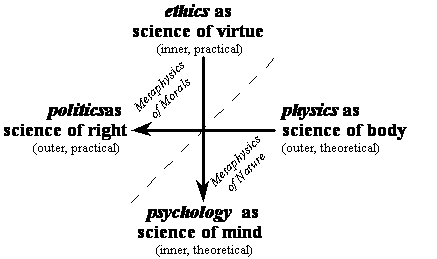
Metaphysical wing of his System to cover four types of science: (1) science of
body (i.e., rational physics); (2) science of mind (i.e., rational psychology);
(3) science of right (i.e., rational politics); and (4) science of virtue
(i.e., rational ethics). The architectonic relationship between these four
branches of Metaphysical Science can be neatly expressed in the form of the
following diagram:[6]
In CJ 170
Kant explains that, although a third Critique
is necessary, "no separate [i.e., third] division of Doctrine is reserved
for the faculty of judgment". Hence, no third book on metaphysics is
necessary either: "with judgement Critique takes the place of Theory
[i.e., of Metaphysics]; ... the whole ground will be covered by the Metaphysics
of Nature and of Morals."
In
1797 Kant published MM, explaining in
the Preface [205] that this book expounds the "science of right" and
the "science of virtue"—the third and fourth divisions of metaphysics
cited above. He also explains that this book "forms a counterpart to the
‘Metaphysical Principles of the Science of Nature,' which have been already
discussed in a separate work (1786)" [205]. This passage, which Förster
unfortunately never mentions,[7]?/span>clearly
indicates that Kant eventually came to regard MFNS as sufficient to serve as a sufficient realization of the "rational physics" aspect of his
planned Metaphysics of Nature.[8]?/span>He was no doubt
aware of the fact that MFNS does not
contain a rational psychology, and had perhaps decided that the Metaphysics of Nature no longer needs
the latter,
since psychology is better pursued as an empirical science.[9]
Reverting
back to this more traditional view of the role of MFNS enables us not only to avoid the five objections raised in §I
against Förster's problematic position, but also to see more order in the
overall structure of Kant's System as it stood in 1798, when Kant wrote his
letter to Garve. Pausing for a moment to specify the precise architectonic
relationship between the books Kant had written up to this point may enable us
to gain an invaluable clue as to the role of OP in Kant's System. The eight major works that make up the
philosophical System Kant constructed during the thirty-one years following the
publication of DSS can be classified
into three types: those following the synthetic
method (viz., the three Critiques);
those companion volumes that support each Critique
by following, for the most part, the analytic
method (viz., PFM, FMM, and RBBR); and those developing the Metaphysical implications of
Critical philosophy (viz., MFNS and MM). This classification of Kant's main
systematic works, which I have defended at length elsewhere [see above, note
4], can be depicted in the following table:
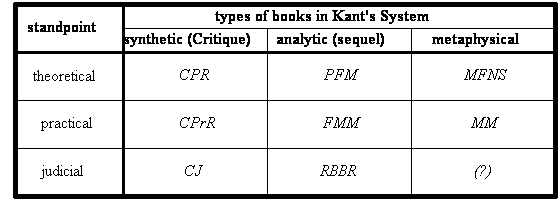
The nature of the first two types of systematic
works is relatively unproblematic, but that of the third type requires more
explanation, especially since this table reveals what appears to be a gap in Kant's System as it stood in
1798.[10]
The
foregoing solution to the second problem raised in §I, together with this
summary statement of the structure of Kant's System, now gives rise to a rather
obvious hypothesis as to how the third problem can best be solved: perhaps the
"gap" Kant mentions in his letter to Garve is identical to the gap
represented by the question mark in the above table; and perhaps Kant's
ultimate goal in writing OP was to
fill this final gap by writing a General
Metaphysics that adopts (like CJ)
what I call the "judicial" standpoint.[11]?/span>In order for
this hypothesis to carry much weight, two questionable points must be
demonstrated: first, that Kant himself (in spite of his above-mentioned
statement to the contrary) had at least considered the possibility of writing a
third part to his Critical metaphysics; and second, that the contents of OP justify regarding it as such a
"grand synthesis".
We
have already seen that Kant explicitly denies the need for a book that would occupy
the empty square in the above table, for he asserts in CJ 170 that the third Critique
will not require a corresponding book
in the Doctrinal part of his System (i.e., in metaphysics proper). But let us
take a closer look at how he describes this situation. A few pages later
[176-179], he states that philosophy technically consists of only two parts,
the theoretical and practical, and that a third
part is necessary only for the purpose of completing the task of establishing
the Critical foundations for metaphysics. He then explains [emphasis added] that
"judgment" is connected with the faculty of "pleasure or
displeasure" in order to "effect a transition from the faculty of pure knowledge, i.e., from the
[theoretical] realm of the concepts of nature, to that of the [practical]
concept of freedom, just as in its logical employment [i.e., within the
theoretical system] it [i.e., judgment] makes possible the transition from understanding to reason."
This
interesting, dual use of the word "transition" gives us an important
clue as to how best to interpret Kant's use of the same word (Übergang) in his letter to Garve. Here
in 1790, Kant is stating that the vital transition within the first Critique (via the role of judgment in
the Principles of Pure Understanding) is analogous to the vital transition in
the Critical philosophy as a whole (via the Critique
of Judgment), and that metaphysics itself requires no such transition.
Instead, he tells us, the principles of judgment can, "when needful be
annexed to one or [the] other [division of pure philosophy] as occasion
requires" [CJ 168]. This usage
is especially interesting in view of the fact that Förster demonstrates, on the
basis not of this passage, but of evidence found in letters to and from
Kiesewetter, that Kant's idea for writing the Transition from MFNS to physics "seems to go back
at least to the year 1790" [GAP
536]. In other words, it seems that in the same year he published CJ, where he claimed that a third
"transition" is possible, though not necessary for the completeness
of his overall System, Kant promised his friend Kiesewetter that he would some
day attempt to write a third transition after all!
We now
have evidence of three kinds of
"transition", strongly suggesting that, when Kant uses this same word
in his 1798 letter to Garve, he has in mind the extension of his "transitional" writings beyond CJ and RBBR to metaphysics itself. Such an interpretation requires us to
assume that, between 1790 and 1798, Kant gradually changed his mind and came to
see a third part of metaphysics no longer as an optional extra, but as an
indispensable part of his System. Whereas in 1790 his friendly gesture to
Kiesewetter committed him to writing only "a few sheets" concerning
this Transition [quoted in GAP 536],
by 1798 this same Transition was causing him to experience "a pain like
that of Tantalus"! What could have caused such a change to occur? My
suggestion is that in 1790 Kant could not bring himself to add yet another
project to the already heavy workload he had cut out for himself. Many of his
letters, even from earlier years, allude to his concern about whether or not he
would live long enough to complete his current plan for a System [see also note
7, above]. As a 66 year old philosopher, who was just on the verge of
completing his Critical propaedeutic
to metaphysics, Kant knew in 1790 that a considerable amount of work still lay
ahead if he wished to expound the System's metaphysical implications: RBBR, MM, and a more complete version of the Metaphysics of Nature still remained to be written, not to mention
his various essays on history and politics. He already found it difficult to
imagine living long enough to complete everything else he had planned, so how
could he possibly commit himself to undertaking yet another major work? Yet, as
each year went by and he completed more and more of his other projects, it
became more and more likely that he would complete them all with some time and
energy to spare; hence, it gradually dawned on him that this third Transition
was too important to be merely "annexed" to other parts of the
System.
If we
consider now the content of OP, we
discover that the notes Kant left behind relate to far more than just a dry
(and perhaps useless) Transition from MFNS
to physics. This, surely, was to be part
of the project he was working on in 1798; and it is important to recognize that
this Transition would belong in a work on General
Metaphysics, because such a book would pass from the theoretical standpoint of MFNS
to the more concrete, judicial
standpoint of physics. Yet many of Kant's notes relate to the practical side of his System, with the
apparent intent of revealing how still another
Transition takes place, this time passing from the practical standpoint of MM
to the more concrete, judicial standpoint of real ethical judgments. For
example, Kant has much to say in OP
about the immediacy of the moral law,
which can be regarded as the very "voice of God" in our heart, and
about the personhood of the God in
whom we intuit all things—even though
this same God is still beyond the grasp of our theoretical knowledge. In such
notes (found especially in the first and seventh fascicles) Kant seems to be
coming closer than ever before to achieving the goal of describing the "Critical
mysticism" which, as I have argued elsewhere [see P4 67-94 and P6 321-323],
characterized his own attitude throughout his entire life.
Our
earlier discussion of DSS
demonstrated that Kant first conceived of the laborious task of reforming
metaphysics as part of a twofold
problem. By 1798 Kant had satisfactorily accomplished his main task of
thoroughly reforming the speculative
tradition, not by disposing of metaphysics altogether, but by constructing a Critical metaphysics to put in its
place. In the works composing the same philosophical System, he had also
already made some significant progress in accomplishing his secondary task of
thoroughly reforming the fanatical
tradition, not by disposing of mysticism altogether, but by constructing a Critical mysticism to put in its place.
For example, he argues in CJ that our
experiences of beauty and purpose in art and nature reveal a depth of
interaction between the noumenal and phenomenal worlds that provides a
transcendental foundation for the kinds of experiences many mystics report of
the "hand of God" in nature. Likewise, he argues in RBBR that religion gives us access to a
power which, though arising out of morality, can alone fulfill the purpose of
our moral nature, so long as we are willing to regard the moral law as the
"voice of God", commanding us in the depths of our heart. What
remained to be accomplished in 1798 was therefore the same for mysticism as it
was for metaphysics: to bring the entire System to fruition by unifying all its
diverse strands under a single, all-encompassing idea.
Although
a detailed analysis of the text of OP
would be out of place at this point, the foregoing hypothesis as to how Kant
viewed its contents can be further substantiated by examining some of the many
notes (especially in the first fascicle) that record what seem to be ideas for
prospective titles. Some of the most
fitting ideas Kant considers are apparently intended as subtitles to the rather
Nietzschian title, Zoroaster. For
example, "Philosophy in the totality of its Conceptual Contents Gathered
Together under One Principle" would emphasize Kant's intention to show how
his entire System springs forth from the common root of immediate experience
[see P6 108-110,118-141]; and
"The Ideal of the Physically and at the Same Time Morally Practical Reason
United in One Sense-Object" expresses explicitly his intention to
synthesize the theoretical ("physical") and practical
("moral") standpoints in the judicial standpoint of sensible
experience [quoted from OP in K1 607]. Such titles suggest that Kant's
purpose was indeed to construct one final "grand synthesis" of his
entire philosophical System —i.e., not just a synthesis of the Critical aspect of that system, which CJ had already accomplished, but a
synthesis of its metaphysical aspect
as well—an "idea of the whole" [see CPR xliv] that would bring together in one "Object" the
doctrines of theoretical reason (physics and psychology) as well as those of
practical reason (politics and ethics). This would indicate that Kant intended OP to be a General Metaphysics in a new form. The new factor, I believe, is
precisely the judicial standpoint
itself; inasmuch as it effects a synthesis
between the theoretical and practical standpoints—i.e., between the exclusively
theoretical "metaphysics of physics" (MFNS) and the exclusively practical "metaphysics of
morals" (MM)—this judicial
standpoint must be what Kant had in mind by his repeated references to the
"highest standpoint of transcendental philosophy".[12]
If my argument is correct, if the "gap" Kant refers to in his
1798 letter to Garve marks Kant's recognition that a third part is also necessary in metaphysics, just as it was in the
Critical works, then the new position Kant adopts in OP reflects not so much a radical change of mind since writing CJ
as a gradual increase in ambition.
For Kant now saw before his eyes the possibility of composing a metaphysical
Doctrine of the unity of all forms of human experience under one transcendental
idea, the idea of "man" [e.g., OP
27] as the being in whom "God and the world"[13]?/span>are one. In
other words, he was reaching out to grasp the opportunity of accomplishing the
ultimate goal he had set for himself in DSS,
by combining in one book the Critical
metaphysics and the Critical mysticism.
As such, Kant's hope of filling the tantalizing gap in his System must refer to
the entirety of OP, which could
perhaps most appropriately be regarded as an attempt to write what we could
call his General Metaphysics of
Experience. Since this interpretation fits in well with all the evidence we
have been considering, I believe a detailed interpretation of OP along these lines would provide the
best way to make sense out of its many diverse twists and turns. Thus, when
Kant writes to Garve, saying "It
must be completed, or else a gap will remain ...", the word "It"
should be taken to refer back to "The project" as a whole, not only
to the "Transition from MFNS to
physics"; the latter forms only the part
of that project that he happened to be working on at the time.
The
solutions I have now proposed to the second and third problems mentioned in §I
make it quite easy to solve the first problem as well. The fact that Kant's
attitude towards mathematics in OP is
different from that in MFNS need not
lead to Förster's rather extreme (and less than flattering) conjecture. A
potential difficulty in solving this problem as Förster presents it is that he
gives only a few hints as to what he believes Kant's new view actually is [GAP
548-550], explaining that a detailed study of the text "obviously ...
cannot here be given" [GAP 551].
The passages Förster quotes from OP
do seem to indicate that, whereas
establishing "the mathematical foundations of physics" was an
important part of MFNS, Kant now
wishes to change his mind and say
that mathematics will not be part of this new
Transition from the Metaphysics of Nature
to physics. From his brief description, it looks as if Förster's conviction
that Kant did change his mind follows as a direct result of his view that MFNS is an extended footnote to CPR. Once we recognize, by contrast,
that MFNS actually takes the place of
the proposed Metaphysics of Nature in
Kant's System, the passages Förster quotes can be readily interpreted in quite
a different way.
Kant's
references to a new role for mathematics in OP
simply indicate that, because a new standpoint
is being adopted in OP, this work
must also adopt a new way of looking at mathematics. MFNS had properly established from the theoretical standpoint the crucial role mathematics must play in
the metaphysics of corporeal nature. The remaining need in OP was to examine from the judicial
standpoint the being of nature
(corporeal and incorporeal) as
experienced (see note 12); and here, mathematics can be put aside as irrelevant.
Thus, when Kant asks himself whether or not "the mathematical foundations
of physics" is an issue that "belongs to the Transition", he is
not asking (as Förster supposes) whether or not the MFNS view needs to be revised
[see GAP 548-549]; rather, by this
question, together with his negative answer, Kant is saying that, because this topic was already
adequately dealt with from the theoretical standpoint in MFNS, there is no need for it to reappear when the standpoint
changes to the judicial, as in the Transition section of OP. In other words, he is saying not only that the function of
mathematics in MFNS and that of this
new, non-mathematical Transition in OP are compatible, but also that they serve parallel functions in
their respective standpoints. This parallelism can be further compared to the moral basis of MM, in the form of the conscience.
By putting together these three branches of Kant's most mature conception of
metaphysics, we can construct the following Table:

We can
now reconsider the passage from MFNS
470, quoted in §I (and in GAP 550),
and see that it actually supports
this solution to the problem. Kant does not say a Philosophy of Nature is absolutely
impossible without mathematics. On the contrary, he says a general doctrine of this sort (i.e., a General Metaphysics of Experience) "may indeed be possible
without mathematics" [MFNS 470];
only the Philosophy of Nature considered from the theoretical standpoint, as a doctrine of "determinate natural
things"—i.e., as the particular
"doctrine of body and doctrine of soul" (the first half being given
in MFNS)—is impossible without
considering the function of mathematics. Once we recognize that Kant intended OP to become the exposition of this General Metaphysics (and that, as
such, it assumes a standpoint that
synthesizes the theoretical and the practical standpoints), there is no need to
regard the anti-mathematical "polemic" in OP as contradicting the mathematical emphasis in MFNS; for its subject-matter is to be
considered from the standpoint of the judicial
wing of Kant's System. OP is
therefore bound to be misunderstood, even by the most meticulous specialist, if
it is read through the closed and relatively bland spectacles of CPR and MFNS, rather than through the more open and fresh spectacles of CJ and RBBR, where Kant's Critical mysticism comes to the fore.
IV. The Tantalizing
"Pain" of Kant's Final Dream
The
common supposition that OP contains
the gropings of a formerly great philosopher as he enters senility is, as
Förster rightly says [GAP 534], not
supported by the actual contents of the text. But what has been ignored up to
this point is that OP is also not a
completely sober work. Rather, in
these notes we see Kant, as it were, becoming intoxicated with the tantalizing
prospects of finally bringing to completion the task he had set for himself
more than thirty years before. Having established in §II the roots of Kant's
motivations for constructing his System of Critical philosophy, and their
connection with both mystical and metaphysical "dreams", we are now
in a position to understand more fully why
the gap he mentions tantalized him as his life drew to a close. As I argued in
§III, the word "gap" must refer to the General Metaphysics of
Experience, for which the eight completed books in his System (viz., CPR, PFM,
and MFNS from the theoretical
standpoint; CPrR, FMM, and MM from the practical standpoint; and CJ and RBBR from the
judicial standpoint) had prepared the way. In other words, the gap is to be
filled by the book OP was intended to
be, whereas the Transition between MFNS
and physics is the specific set of arguments within OP that Kant was
working on in September of 1798. This means that, although Förster is right in
refusing to identify the gap with the Transition, the intricate hypothesis he
proposes to explain their difference is untenable.
The
main task of this final section will be to demonstrate the appropriateness of
Kant's reference to the pain of Tantalus. Before doing so, however, I shall
respond to two objections a supporter of Förster's interpretation might make to
the view I have presented. The first is that Kant explicitly describes the gap
as being in his "critical system", yet if we distinguish between the
broad sense of "Kant's System", as referring to all his major
philosophical works, and the narrow sense of these words, as referring only to
the three Critiques, then the gap as
I have interpreted it is not actually a part of the Critical System. The gap as Förster sees it, by contrast, is at the
very heart of the first Critique itself! My response to this
objection would be to say that Kant often uses the same term in both a narrow,
technical sense, and elsewhere in a broad, looser sense.[14]?/span>Thus it is not
unreasonable to suppose that Kant, whose whole way of doing philosophy had
become known by 1798 as the "Critical philosophy", would use this
phrase to include the works that set forth the metaphysical implications of the
three Critiques. Although it would
have been more accurate to say he saw a gap in the metaphysical application of his Critical philosophy,
Kant's loose reference to the gap as being somewhere in the Critical philosophy need not imply the sudden recognition of
any major defect in the Critiques
themselves. Moreover, on Förster's interpretation, whereby the gap refers to
the need for a new way of defending the objective validity of the categories
and so also the connection between metaphysics and physics, the gap would be
more appropriately described as a localized
error in the first Critique, than as an empty hole in the
overall System. Kant's wording
implies that an entire book is missing, not just an argument within a book.
A second
objection is that my interpretation does not explain why Kant made no mention
of the gap before 1798. Förster's key hypothesis rests on the assumption that
this timing is a vital clue to the proper explanation of the facts. This is
what leads him to conjecture that the publication of Selle's prize essay
question prompted Kant to reconsider the role of mathematics in philosophy.
There is, however, a much simpler and less presumptuous alternative. Kant's use
of the word "gap" in his letter to Garve is most likely nothing more
than an off-the-cuff remark, intended as part of his metaphorical reference to
the myth of Tantalus.[15]?/span>So let us now
examine that myth in more detail.
Tantalus
was a legendary Greek king who had found much favor in the sight of the gods.
He was not only often entertained at their table, but "was himself on
occasion their host" [R1 68].
However, at one point he did something that "offended them beyond
pardon." In one version of the story, he serves the gods human flesh to
test their omniscience, while in another he steals their nectar and serves it
to his fellow humans. As punishment he is made to be "forever hungry and
thirsty; he stands in a pool of water up to his chin, but whenever he tries to
drink, it drops away from him. Overhead are boughs laden with fruit, but when
he reaches for it, the wind blows it away" [R1 68].
Förster's
interpretation portrays Kant as knowing what needs to be done, just as Tantalus
knew that food and drink would satisfy his hunger and thirst. However, it
requires us to identify the unfulfilled desire with an object (a missing
theory) which Kant could not at that point see clearly, whereas for Tantalus
the everlasting torment was caused not so much by his lack of food and drink as such, but by their close proximity combined with their
inaccessibility. If Kant was using his analogy with as much care as he normally
did when speaking metaphorically [see A1
and T1], then the true referent of
the "gap" must be something Kant both desired and saw before him, but was prevented
from reaching (i.e., describing) by some uncontrollable force—a force that he
says makes him "as it were mentally paralyzed". The word
"gap" would then be carefully chosen to put a vivid picture before
our eyes: the remaining book of his System is being compared to Tantalus' lips
and hands; and the "pain" is caused on the one hand by the gap
between these lips and the "water" of Kant's theoretical system
(especially MFNS), and on the other
hand by the gap between these hands and the "fruit" of Kant's
practical system (especially MM). The
word "gap" is simply an intentionally metaphorical description of the
relation between the book he was then working on (viz., OP) and the rest of his philosophical System, as depicted in the
following diagram:

Once this is recognized, it becomes clear that Kant
had in fact referred to this gap on numerous previous occasions, except that
elsewhere he normally referred to it literally
(e.g., when discussing the parallels between metaphysics and Critique).
Kant's
famous letter to Garve was written in response to a letter in which Garve
describes his long-standing and agonizing physical illness ("a malignant
tumor of the face"), yet expresses surprise over the fact that he is still
able to think clearly [KPC 250-251n].
Kant replies in a way that might seem rather unsympathetic. Immediately before
the passage quoted at the beginning of this paper, Kant says: "I wonder
though whether my own fate, involving a similar striving [i.e., "to work
for the good of mankind"], would not seem to you even more painful, if you
were to put yourself in my place" [251]. If Kant has the temerity to say
such a thing in response to the sufferings of a long-standing friend, he must
have been quite serious about his subsequent reference to Tantalus. In other
words, he must have been feeling that, because his Critical philosophy had
questioned the omniscience of the (false) gods of mankind (through the transcendental
limits of knowledge established in CPR),
or perhaps because one of its central goals was to offer the "nectar of
the gods" to mankind (through the moral law established in CPrR), he was being punished by being
kept from describing the dream he saw so clearly, right before his eyes.
In any
case, it is worth noting in conclusion what appears to be the one and only
qualification Kant adds to his use of the analogy of Tantalus: whereas Tantalus
was condemned to endure his torment forever, Kant stresses that his own
tantalizing pain "is not a hopeless pain", because "[r]eason
will not give up her demands for this". In fact, this may not be so much a
qualification as a reminder of how appropriate the analogy is. From Tantalus'
point of view, after all, the food and drink must have seemed to be well within his reach. A desirable object cannot tantalize us unless there is some hope that the goal can be reached. In
the same way Kant's ideal of a "grand synthesis", in which his
lifelong adherence to a Critical mysticism quite distinct from that of
Swedenborg's could be described in all its glory, as the natural conclusion to
his Critical metaphysics, must have seemed to Kant to be just within his reach,
if only he could think clearly for a few more years. Once this is understood,
however, we can see that his mental paralysis may have been caused not so much
by senility (which normally has physical
roots, after all), but by the simple fact that any attempt to describe the indescribable is bound to leave us
speechless.
Kant's
reference to the hopefulness of reaching his goal only emphasizes the
appropriateness of the comparison with Tantalus. For as it has turned out, Kant
left the philosophical world with a text (OP)
that will forever tantalize its readers precisely because it seems to put us
within reach of a philosophical vision
of the unity of Mind and Nature in their inner and outer aspects, yet recedes
just beyond our reach when we try to describe that vision in words. Kant
himself may have recognized the necessity of our continued failure in this
regard. Indeed, before the dreams of DSS
ever awakened in him the desire to construct a System of Critical philosophy,
Kant explained in the conclusion of his Universal
Natural History and Theory of the Heavens that "a great vision"
of Nature is available to all who are open to it, even though the resulting
experience cannot be fully described. His words, alluding to the tantalizing
pain involved in trying to express the inexpressible—a pain he had felt for so much of his life[16]?/span>and hoped in
1798 finally to express—would perhaps
have made a fitting conclusion to OP
as well:
In the universal silence of Nature and in the calm
of the senses the immortal soul's faculty of knowledge speaks an ineffable
language and gives undeveloped concepts, which are indeed felt, but do not let
themselves be described. [ANTH 367]
FOOTNOTES
