Campus Digest
HKBU to honour four distinguished persons at 55th Commencement
22 Oct 2014
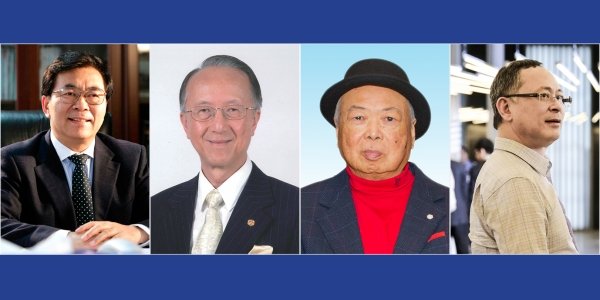
(Updated on 30 October 2014) Hong Kong Baptist University (HKBU) will confer honorary doctoral degrees on four distinguished persons at its 55th Commencement on 17 November for their outstanding academic, research or professional achievements as well as their remarkable contributions to society.
Professor Bai Chunli (白春禮), a renowned scientist, will be awarded the degree of Doctor of Science, honoris causa. Dr Cecil Chan Shu-on (陳樹安), a distinguished consulting engineer and entrepreneur, will be awarded the degree of Doctor of Humanities, honoris causa. Mr Hui Yin-fat (許賢發), an outstanding leader in social welfare services, will be awarded the degree of Doctor of Social Sciences, honoris causa. Dr Johnnie To Kei-fung (杜琪峯), a famous film director and producer, will be awarded the degree of Doctor of Letters, honoris causa.
Professor Bai Chunli (Doctor of Science, honoris causa)
Professor Bai Chunli, a world renowned scientist, is currently President of the Chinese Academy of Sciences (CAS) and The World Academy of Sciences, and Honorary President of the University of Chinese Academy of Sciences. He is also the Founding Director of the National Centre for Nanoscience and Technology and Chief Scientist of the National Steering Committee for Nanoscience and Technology.
Professor Bai is the first Chinese scientist to actively engage in research in nanotechnology, and one of the pioneers in the field of scanning tunnelling microscopy. Under Professor Bai’s leadership and coordination, his research team successfully developed the first computer-controlled scanning tunnelling microscope (STM) operating at ambient condition, the first low-temperature STM, the first ultrahigh vacuum-STM, the first laser atomic force microscopy and the first ballistic electron emission microscopy in China. Professor Bai has authored 12 monographs and presented more than 350 scientific publications in refereed journals. He also owns over 10 patents for his inventions and applications.
He is Member of CAS and Fellow of The World Academy of Sciences, Elite Foreign Associate of the National Academy of Sciences in the US, Foreign Member of the Royal Society in the UK, Honorary Fellow of the Royal Society of Chemistry in the UK, Foreign Member of the Russian Academy of Sciences, Member of the German Academy of Sciences and Engineering, Member of the Royal Danish Academy of Sciences and Letters, and Honorary Fellow of the Indian Academy of Sciences. He was conferred honorary doctorates by the University of York in the UK, University of Minnesota in the US, Lund University in Sweden, Roskilde University in Denmark, and The University of Queensland in Australia. In 2001, he was conferred International Medal by the Society of Chemical Industry, UK. In 2010, he was awarded “Medal of Contributions to Development of Nanoscience and Nanotechnology” by the United Nations Educational, Scientific and Cultural Organization, becoming the first Chinese scientist to receive this honour.
In 2002, owing to Professor Bai’s advocacy, the Joint Institute of Environmental Sciences of HKBU and Research Centre for Eco-Environmental Sciences of CAS was established. In 2013, the Research Centre for Eco-Environmental Sciences of CAS collaborated with HKBU to establish at the University the Partner State Key Laboratory of Environmental and Biological Analysis (HKBU). By integrating the strengths of biological science, environmental science and material science, this collaboration serves to foster quality development in the testing of persistent toxic pollutants and food safety in Hong Kong and Mainland China.
Dr Cecil Chan Shu-on (Doctor of Humanities, honoris causa)
Dr Cecil Chan is a consulting engineer and entrepreneur. He served as the chief electrical design engineer at the Taikoo Dockyard and Engineering Company Ltd. He also served as Technical Director at the Federation of Hong Kong Industries, and shortly thereafter as CEO of the organisation. He is the founder of the Everite Group of companies where he served as Chairman of the Board and CEO for over 25 years until his retirement in 2008. Under his leadership, the Group was granted over 30 international patents from the US, Europe, the UK and China for their designs and manufacturing of novelty toys and gifts for overseas export.
Dr Chan undertook a leading role in establishing Hong Kong’s first multi-disciplinary product-testing and field certification laboratory, which sought to provide guidance and consultative services to the manufacturing industry regarding quality controls and compliance as well as to promote sector-wide adherence to higher quality standards for all manufactured goods. Under his leadership, the Hong Kong Standards and Testing Centre was launched. In order to enhance the quality-image of Hong Kong’s manufactured products among local and overseas customers, Dr Chan pioneered the concept and the implementation of a highly successful quality labelling scheme entitled the Hong Kong “Q-mark” Scheme. The Scheme certifies products and services which meet the quality and safety standards recognised throughout the territory.
Dr Chan is currently the Honorary President of the Chinese YMCA of Hong Kong. He facilitated the establishment of University- and College-based YMCAs in the major local tertiary institutions, including at HKBU, so as to provide students with leadership training. He has also served as Treasurer and Chairman of the Finance Committee of the World Alliance of YMCAs, and the Vice President and Treasurer of the Asia and Pacific Alliance of YMCAs. In 2000, he received an Outstanding Leadership award from the World YMCA.
In 1979, Dr Chan began his first term of service on the Board of Governors of the then Hong Kong Baptist College. As Deputy Chairman of the Board of Governors, he was a strong proponent of the College’s eventual transformation from College to University status. Since then, he has served HKBU as Member of the Court and Council and Chairman of the University Personnel Committee. He continues to serve as one of the Honorary Presidents of the HKBU Foundation and Member of the Foundation Board of Governors.
Mr Hui Yin-fat (Doctor of Social Sciences, honoris causa)
Mr Hui Yin-fat is an outstanding pioneering social work leader in Hong Kong. He not only dedicated himself to the development of social welfare services and social work education, but also advocated social welfare policies, the effects of which continue to impact Hong Kong today. He is well deserved to be called “Welfare Hero”. Mr Hui was elected to the Legislative Council as the representative of the Social Welfare functional constituency. In 1992, he was appointed to the Executive Council where he proactively reflected to the Government the views and opinions of the social welfare profession. He played a leading role in the institution of the Comprehensive Social Security Assistance Scheme and the setting up of a Central Provident Fund Scheme. Through his strenuous efforts, legislation regulating residential care homes for the elderly was written into law, as was the Social Workers Registration Ordinance.
In 1973, Mr Hui was appointed Director of The Hong Kong Council of Social Service (HKCSS), becoming its first Chinese Director since its foundation in 1947. During his tenure as Director, the HKCSS became a platform for professional exchange and networking among the members, establishing a high level of welfare service standards. He enabled the establishment of two service organisations, the Agency for Volunteer Service and the Hong Kong Physically Handicapped and Able-Bodied Association, which remain as effective today as they were at their inception. Mr Hui also facilitated the setting up of HKCSS’s career counselling service as an independent entity, thus making possible the Hong Kong Employment Development Service Ltd, which offers more extensive and effective services to a wider community.
Mr Hui is a renowned leader, not only in the Asia-Pacific region, but also globally for his advocacy of best practices in social welfare services. He was elected President of the International Council on Social Welfare, Vice President of the International Federation of Social Workers and Vice President of the International Federation of Ageing, contributing significantly to China’s entry into the organisation as a Member.
Mr Hui dedicated himself to social work training as well. From 1986 to 1998, he chaired the Advisory Committee of the Social Work Department of HKBU. As Chairman of the Committee, Mr Hui lent his expertise to the development of the University’s Bachelor’s Degree in Social Work.
Mr Hui retired in 2001, but his concern and support for the education and development of social workers persist through his personal donation to set up the Y. F. Hui Social Work Trust Fund under the Hong Kong Social Workers Association. The Fund now stands as a fitting legacy to Mr Hui, an advocate for social work through continuous learning and training, both in Hong Kong and overseas.
Dr Johnnie To Kei-fung (Doctor of Letters, honoris causa)
Dr Johnnie To, a famous film director and producer, has played an instrumental role in the development of the Hong Kong film industry.
In 1972, Dr To joined Television Broadcasts Ltd (TVB) and became a producer and director in TVB’s Drama Division in 1977. The well-known TV drama series he produced include Chinese Folklore (民間傳奇), Yesterday’s Glitter (京華春夢) and Legend of the Condor Heroes (射雕英雄傳). In 1979, Dr To made his first directorial debut with the film The Enigmatic Case (碧水寒山奪命金). In 1996, he co-founded with Mr Wai Ka-fai Milkyway Image (Hong Kong) Ltd, for which he produced and directed a series of films with a distinctive local flavour that were noted for their creativity, including A Hero Never Dies (真心英雄), Running Out of Time (暗戰) and The Mission (鎗火). In the past three decades, Dr To has directed and produced more than 70 films of diverse genres and cinematic styles. With decades of hard work, Dr. To’s films has become the emblem of Hong Kong filmography on the global stage.
Dr To was named best director three times in the Hong Kong Film Awards, three times in the Golden Horse Awards of Taiwan, six times in the Hong Kong Film Critics Society Awards, and three times in the Golden Bauhinia Awards. He also received numerous nominations and commendations from film societies in Asia-Pacific, Europe and the US. To date, Dr To’s award list tops any Chinese film director. In 2009, he was awarded the French Order of Arts and Letters by the Ministry of Culture of France; in 2010, he was awarded the Honorary Fellowship by Lingnan University, Hong Kong; in 2011, he was awarded the Medal of Honour by the HKSAR Government; in June 2014, he was awarded an Honorary Doctorate by the Hong Kong Academy of Performance Arts. Dr To has received lifetime achievement awards in international film festivals in Spain, the Netherlands and Switzerland in recognition of his contributions to film arts.
Besides the achievements in film production and film directing, Dr To has devoted tremendous efforts to grooming local talents. In 2004, he became a member of the Hong Kong Arts Development Council and soon after started chairing the Film and Media Arts Group of the Council. In 2005, he initiated the Fresh Wave Short Film Competition which evolved in 2010 into an international short film festival, further fostering cultural exchange among international filmmakers.
For many years, Dr To has maintained close contacts with HKBU by giving talks and guest lectures for the benefit of students, in particular those studying in the Academy of Film and the Department of Humanities and Creative Writing.