Press Release
HKBU signs MOU with international institutions to drive innovations in GreenTech
Monday, 22 September 2025
Hong Kong Baptist University (HKBU) has established a collaboration with the Technical University of Munich (TUM) from Germany, German research organisation Fraunhofer-Gesellschaft, Nanyang Technological University (NTU) from Singapore, and other leading organisations to drive green technology (GreenTech) advancement and applications with cross-disciplinary research in areas of hydrogen value chain and waste valorisation solutions. The collaboration aims to address the pressing challenge of climate change and support Hong Kong in striving towards carbon-neutrality.
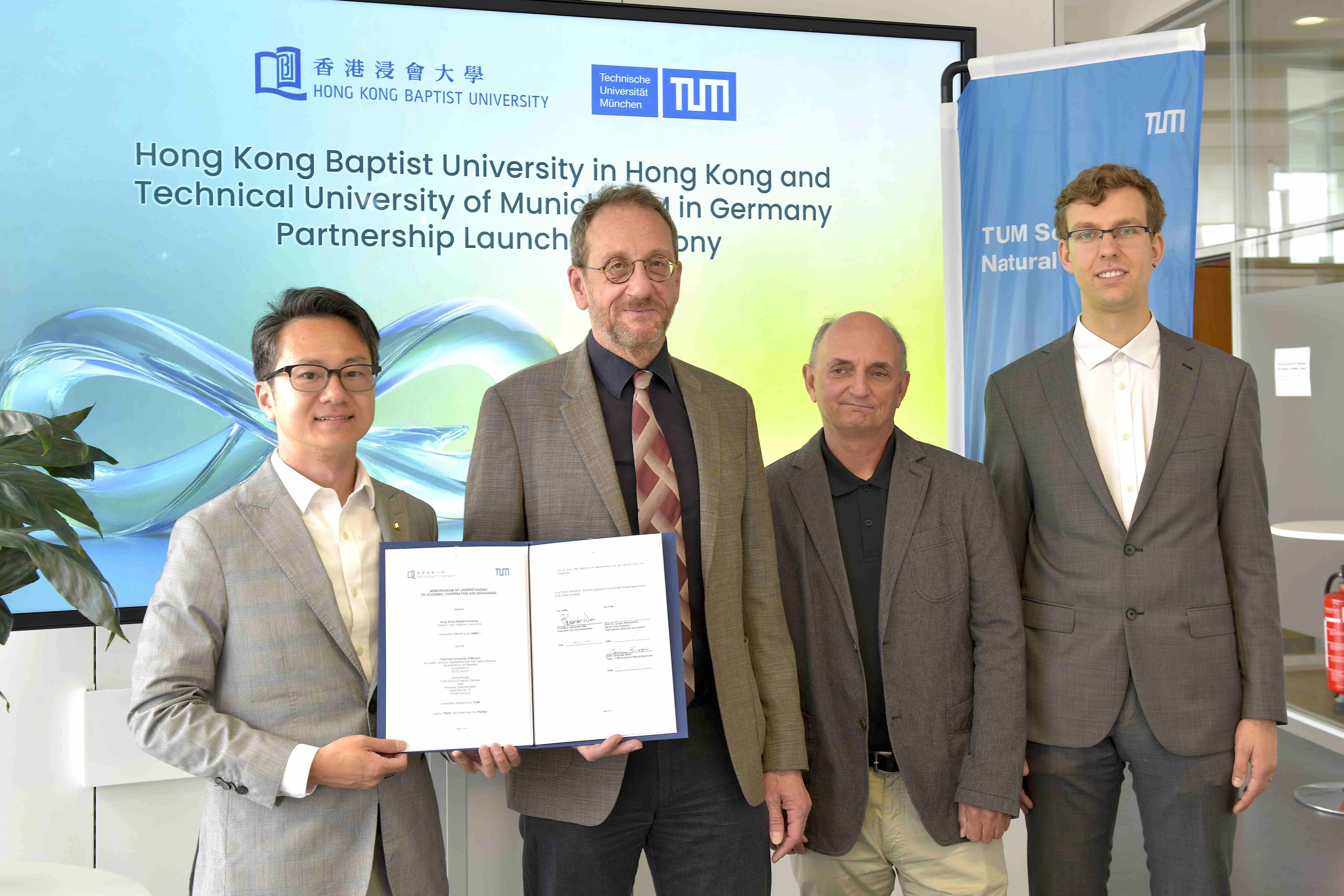
A Memorandum of Understanding (MOU) was signed earlier between HKBU and TUM as well as five research institutes under Fraunhofer-Gesellschaft (including the Institute for Interfacial Engineering and Biotechnology IGB, Research Institution for Individualized and Cell-Based Medical Engineering IMTE, Institute for Microstructure of Materials and Systems IMWS, Research Institution for Materials Recycling and Resource Strategies IWKS, Institute for Environmental, and Safety and Energy Technology UMSICHT), with support from NTU. The collaboration will focus on joint research, technology transfer, and commercialisation in the areas of hydrogen value chain and waste valorisation solutions, leveraging HKBU’s strengths in interdisciplinary innovation to create real-world impact.
The Institute for Innovation, Translation and Policy Research (ITPR) and the Faculty of Science at HKBU have partnered with academic and industry partners to develop advanced technologies for the production, storage, transportation, and utilisation for hydrogen, which holds significant promise for meeting future needs for clean and sustainable energy. The collaboration partners will contribute their expertise in biowaste valorisation, electrochemical and catalytic processes, catalysis, and computational modelling.
The collaboration also aims to apply cutting-edge science and engineering to transform plastic and organic waste into high-value materials, capture carbon dioxide into food and building materials, and use of shrimp shells to produce chitosan-based renewable coating and textiles, offering eco-friendly alternatives to harmful PFAS (Per- and Polyfluoroalkyl Substances) finishes.
Mr Tobby Fu, Director of ITPR at HKBU, highlighted, “The collaboration marks a transformative leap for HKBU in GreenTech applied research. Our partnerships extend beyond academia and the research institute to include industry leaders for practical applications, investors for scaling breakthroughs, support from government units in Mainland China responsible for policy matching, and platforms for project alignment, igniting innovations which deliver real-life impacts through technology transfer and commercialisation. These efforts perfectly align with the HKSAR Government’s ‘Zero Waste Bay Area’ initiative and the Strategy of Hydrogen Development in Hong Kong, driving sustainable growth across the region.”
Professor Dr Thomas Brueck, Werner Siemens Chair of Synthetic Biotechnology of the School of Natural Science at the Technical University of Munich, remarked, “The anthropogenic waste streams of the urban environment offer a new undervalorised resource for the generation of renewable, drop-in chemicals, materials and fuels using AI-guided catalytic conversion and process engineering approaches. For the first time, the interaction between HKBU and TUM for residue valorisation will develop compact technology solutions for urban waste transformation. The cooperation of HKBU, TUM and the Fraunhofer institutes will enable rapid technology scaling and industrial process adoption that not only address Hong Kong’s sustainability goals but also serves as a globally visible lighthouse for innovation in urban residue valorisation.”
Professor Xu Rong, Research Director for Engineering and Physical Sciences, Director of the Singapore Energy Consortium, and Professor of the School of Chemistry, Chemical Engineering and Biotechnology at Nanyang Technological University added, “We are thrilled to be part of the research and development collaboration on hydrogen innovations, which represents a significant step forward in advancing green hydrogen technologies. The collaboration combines expertise from leading institutions across the globe and we aim to accelerate the development of sustainable hydrogen production, storage, and utilisation systems. Our collaborative work not only pushes the boundaries of scientific innovation but also creates tangible pathways for technology transfer and industrial adoption, ultimately contributing to a cleaner and more sustainable future for society.”
With the support from numerous industry and institutional partners contributing their expertise and infrastructure, including the Barcelona Supercomputing Center from Spain, the Institute of Sustainability for Chemicals, Energy and Environment at A*STAR Research Entities from Singapore, the Leibniz Institute for Catalysis from Germany, the National University of Singapore, the Hong Kong Science and Technology Parks Corporation, and the Hong Kong-Shenzhen Innovation and Technology Park, the partnership will foster technology transfer, commercialisation and the projects’ sustainability.
-End-