Press Release
HKBU to confer honorary doctoral degrees upon five distinguished individuals
Tuesday, 3 November 2026
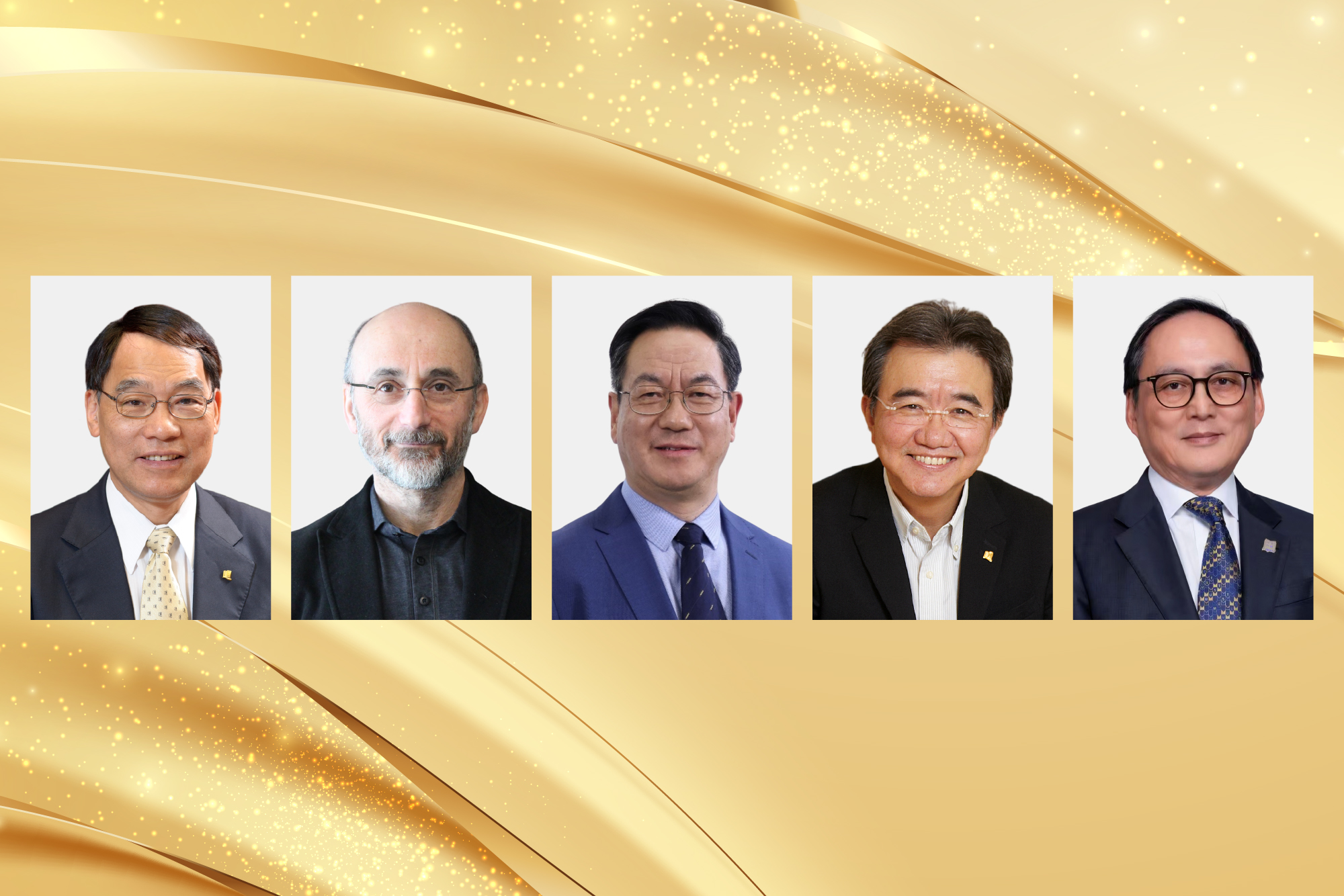
Hong Kong Baptist University (HKBU) will confer honorary doctoral degrees upon five distinguished individuals on 16 November this year, in recognition of their outstanding professional accomplishments and remarkable contributions to society. The recipients are Professor Albert S C Chan, Professor David Moher and Professor Zhong Lin Wang , who will each receive the degree of Doctor of Science, honoris causa; Professor Roland T Chin, who will receive the degree of Doctor of Engineering, honoris causa; and Professor Manson Fok, who will be conferred the Doctor of Social Sciences, honoris causa. (Brief profiles of the five honorary doctoral degree recipients are set out below.)
HKBU will confer honorary doctoral degrees on a total of six distinguished individuals this year. Dr Andy Lau Tak-wah received the degree of Doctor of Letters, honoris causa, in August.
Professor Albert S C Chan (Doctor of Science, honoris causa)
Professor Albert S C Chan has distinguished himself as a world-leading applied organic chemist and academic leader. His research has contributed meaningfully to important breakthroughs in chemical technology, life sciences, and Chinese medicine. He has also served as the capable leader of institutions of higher learning in the Hong Kong Special Administrative Region (HKSAR) and the Chinese Mainland.
What is especially noteworthy is Professor Chan’s discovery known as “synthetic chiral catalysis”. Tiny amounts of highly effective chiral catalysts can help produce large amounts of chiral materials, which are important for subsequent development into foods, medical applications and specialty materials. His adept handling of chiral catalysis resulted in the synthesis of single-enantiomer cancer drug candidates which show high potential in cancer treatment. The application of the technique improves anti-cancer drugs’ therapeutic effectiveness and reduces toxicity and harmful side effects. Professor Chan has truly been a pioneer of “translational medicine” and technology transfer. His pursuit of identifying therapeutically effective ingredients from Chinese herbal medicines and natural products resulted in highly effective cholesterol- and triglyceride-lowering substances.
Professor Chan served as the President and Vice-Chancellor of HKBU from 2010 to 2015 and has held leadership positions at The Hong Kong Polytechnic University and Sun Yat-Sen University. He has rightly been considered the visionary pioneer of regional integration, advocating and championing inter-institutional capacity-building for industry-relevant applied research that joins institutions and initiatives across Hong Kong, Shenzhen and Guangzhou. He was elected as academician of the Chinese Academy of Science in 2001 and appointed a Justice of the Peace by the Government of the HKSAR in 2012.
Professor David Moher (Doctor of Science, honoris causa)
Professor David Moher is a preeminent Canadian epidemiologist who has demonstrated global leadership and capacity-building in scholarly guidance, results reporting, and systematic review in randomised clinical trials.
Despite being denied admission to his first-choice university programme and being twice rejected from graduate school, Professor Moher persevered, driven by a passion for research and writing, and an unwavering refusal to surrender. He was eventually invited to pursue a doctorate.
He spearheaded the development and updates of the CONSORT (CONsolidated Standards of Reporting Trials) guidance. First launched in 1996, CONSORT provides a minimum set of recommendations for reporting randomised controlled trials (RCTs). His leadership in the 2001 and 2010 revisions, and most recently the 2025 refinement, has resulted in its endorsement by over 500 biomedical journals worldwide. Professor Moher was also instrumental in the establishment of the Preferred Reporting Items for Systematic Reviews and Meta-Analyses (PRISMA) guidelines. PRISMA and its later extension, PRISMA-S, strengthen the integrity and consistency of systematic reviews and meta-analyses.
In 2021, in collaboration with Professor Bian Zhaoxiang, Associate Vice-President (Clinical Chinese Medicine) at HKBU, Professor Moher established an EQUATOR Network Centre at HKBU, with the mission to enhance the quality and transparency of health research. The standards emerging from the HKBU-EQUATOR partnership promise a higher-level synthesis of Chinese and Western medical knowledge, transforming existing global standards for RCTs into more localised, data-driven, and replicable clinical trial practices for scholars and medical practitioners in China and around the world.
Professor Zhong Lin Wang (Doctor of Science, honoris causa)
Professor Zhong Lin Wang is widely recognised as “the father of nanogenerators”, with pioneering achievements in nanoscience and nanotechnology. His discovery of piezotronics and the development of triboelectric nanogenerators (TENGs) have advanced energy harvesting and enabled new applications in sensors, robotics and human-machine interfaces.
Life for Professor Wang began on a farm in Pucheng County in Shaanxi province. Benefiting from the national policy of “Reform and Opening-up”, he was admitted to university. In 2007, he discovered piezotronics, finding that applying mechanical stress to certain zinc oxide nanowires generates a “gate voltage” that tunes the transport of charge carriers (electrons and holes). In 2012, Professor Wang and his team invented TENGs by embedding certain types of material with tiny patterns to increase friction.
Professor Wang has authored over 2,000 peer-reviewed journal articles and holds over 160 US and foreign patents. He has received numerous prestigious awards, including the Global Energy Prize, the Albert Einstein World Award of Science. His achievements have also earned him memberships and fellowships in some of the world’s most esteemed scientific academies. Professor Wang is also a respected educator who has advised over 350 master’s and doctorate students, postdoctoral researchers and visiting fellows. In 2020, he founded the Beijing Institute of Nanoenergy and Nanosystems, which he continues to lead today.
Professor Roland T Chin (Doctor of Engineering, honoris causa)
Professor Roland T Chin is a pioneering computer scientist, a builder of institutions and a leader. His research in robotic vision helped advance artificial intelligence (AI) and automate satellite remote sensing. He has also contributed to the advancement of higher education, strengthened academic institutions and extended Hong Kong’s contribution to the wider world.
Professor Chin served as the Chairman of the Research Grants Council (RGC) from 2005 to 2012. The architecture of support he helped establish endures across the education and research landscape. He originated or directly fostered the RGC Theme-based Research Scheme, the Area of Excellence Scheme, the Humanities and Social Sciences Fellowship Scheme, among others, together with the first five publicly funded R&D centres under the Innovation and Technology Commission. The Government of the HKSAR appointed him a Justice of the Peace and awarded him the Bronze Bauhinia Star.
From 2015 to 2020, Professor Chin served as the President and Vice-Chancellor of HKBU. Advancing the aspiration to become “a liberal arts university in Asia for the world”, he launched the Talent100 initiative to bring outstanding scholars into areas of strategic promise. In 2018, he established “AI in X” as a University research focus, inviting disciplines across the campus to explore both the promise and the perils of AI technologies. He was also the first mover and fundraiser for the Jockey Club Campus of Creativity at HKBU, and planned and liaised between HKBU and the Government of the HKSAR to develop on Hong Kong’s first Chinese Medicine Hospital.
Professor Manson Fok (Doctor of Social Sciences, honoris causa)
Professor Manson Fok is a specialist in minimally invasive endoscopy. He has made distinguished contributions to medical education and healthcare innovation, and provided exceptional leadership in founding Macau’s first medical school.
As the ninth of 13 children of Dr Henry Fok, one of Hong Kong’s most eminent entrepreneurs, Professor Fok chose to take the path as a medical doctor, which requires rigorous training, instead of going into business. In 2019, he became the first doctor-scholar to start a medical school in Macau. He is the founding Dean of the Faculty of Medicine at Macau University of Science and Technology, with a vision to provide top notch clinical training for medical students in Macau who meet international standards, so that the city can integrate into the Greater Bay Area medical hub.
In 2009, Professor Fok’s contribution in the field of endoscopy was recognised by ENDOS Medical Science and Technology Award and he received the International Outstanding Leadership Award in Endoscopy. In 2026, he was recognised as one of the “100 National Outstanding Physicians” by the National Health Commission of the People’s Republic of China.
Professor Fok also supported HKBU in its preparatory work for a new medical school in 2025, to integrate traditional Chinese medicine with western medicine to meet the growing demands for medical professionals and medical education in the Greater Bay Area. His leadership and rich experience in clinical training models, infrastructure planning and international collaboration were instrumental in the founding of HKBU’s Frontier Translational Medical Research Institute last year. He has helped HKBU realise the Institute’s mission of bringing cutting edge medical research into real-world applications.