Campus Digest
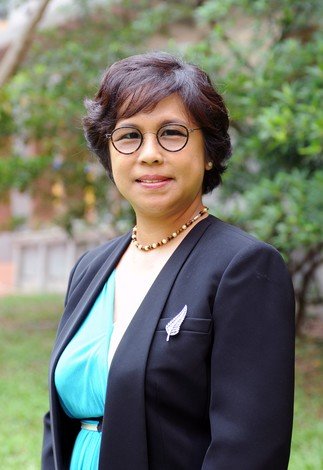
Dr Theresa Cunanan: Advocating ethnic harmony
26 Nov 2018
"Though Hong Kong is dubbed Asia’s World City, there is still racial discrimination and segregation around us. We still have a long way to go in order to achieve racial harmony."
As a Senior Lecturer in the College of International Education (CIE) under the School of Continuing Education, and a Hong Kong-born Filipino, Dr Theresa Cunanan is ideally placed to assess Hong Kong’s attitudes towards different ethnicities.
Growing up in the 70s and 80s, during her formative years Dr Cunanan was unable to study Chinese, as at that time most non-Chinese students in Hong Kong were taught French instead. As a result, many adolescents growing up in Hong Kong reached a glass ceiling after high school because many, like Dr Cunanan, could not read or write the local language. Over time this became a big disadvantage, hindering many from moving upwards due to the lack of a first degree.
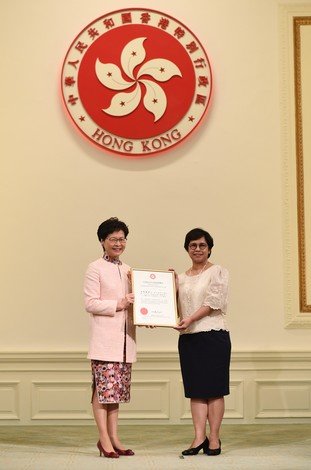
Awarded the Chief Executive's Commendation for Community Service this year, Dr Cunanan has long devoted herself to public service in hope that she could be an advocate and voice for ethnic equality in Hong Kong. Driven by her previous experiences, Dr Cunanan’s first step was to research the segregation situation in Hong Kong schools. In particular, she wanted to find out why so few ethnic minorities were given a chance to study at university level in Hong Kong.
Her early experience of inequality and discrimination later inspired her to work on a PhD, entitled Dividing Classes: Segregation of Ethnic Minorities in Hong Kong Schools, which looked at ethnic inequality and the segregation present in the local education system. Despite this work, years later after 1997, she found that the situation had not improved and was instead getting worse.
Despite having lived in Hong Kong since 1964, Dr Cunanan's parents also faced difficulties and bias because they are in the ‘non-Chinese speaking minority'. While many hoped that the situation would improve with the enactment of the Race Discrimination Ordinance, Dr Cunanan points that even with the RDO, there is still a long way to go. This is especially true as the education system continues to be particularly badly affected.
"To a certain extent, the term 'ethnic minorities' is already a kind of discrimination,” says Dr Cunanan. “Why do we try to differentiate people as majority and minority?"
Dr Cunanan explains that today, the majority of the non-Chinese population are still not considered as local Hongkongers due to their skin colour, language, religion and culture, even though they may have long settled in Hong Kong.
"Today, among the local government-funded main-stream schools, over 20 of them have only non-Chinese students, which is almost double the number ten years ago. In other words, even though the schools are government-funded, Chinese parents are unwilling to send their children there because there is an unspoken fear that there are too many ethnic minorities already studying in that particular school. Eventually, racial segregation is inadvertently created at these schools because fewer and fewer Chinese parents want to send their own children where there are increasing numbers of ethnic minority students," she says.
Dr Cunanan graduated from Diocesan Girls' School (DGS) and furthered her study at The University of Hong Kong. After that, she returned to her alma mater, DGS to teach English and English Literature for 10 years before she joined CIE in 2001. Although not ethnically Chinese, she considers herself a Hongkonger, and as a member of the education sector, Dr Cunanan often feels disheartened when she hears about segregation in schools.
In 2015, Dr Cunanan was invited by the HKSAR to join the Committee on the Promotion of Racial Harmony and the Human Resources Planning Commission, providing advice on government policies and in particular those relating to ethnic minorities in Hong Kong. She also gives speeches in the local community, sharing her story and engaging in activities for underprivileged non-Chinese youth in order to spread the beauty of living in a diverse culture. The aim is that this will enable a better understanding and earlier integration into Hong Kong society.
“We should promote multiculturalism to support the non-Chinese speaking population,” says Dr Cunanan. “Our children will be more culturally aware, and be able to empathise with people from different cultural backgrounds, eliminating fear and discrimination."
As in the words of Dr Cunanan, achieving ethnic harmony is a marathon: the road may be long and full of obstacles but we need to keep fighting for the sake of the generations to come.