Discover HKBU
Powering pitch-perfect translation and game localisation through GenAI
30 Jun 2026
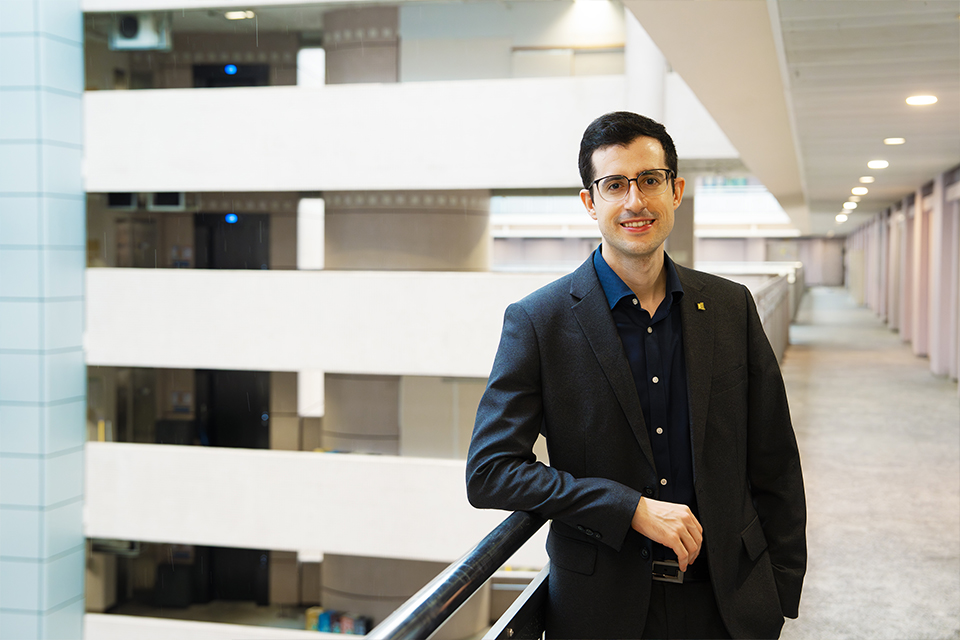
As one of the recipients of the President’s Award for Outstanding Performance 2025-2026 in Early Career Teaching, Professor Luis Damián Moreno García, Assistant Professor of the Department of Translation, Interpreting and Intercultural Studies, offers his students the best of both worlds. They have the opportunity to learn translation through localising video game content in Professor Moreno García’s course, “Video Game Localisation”, the first specialised undergraduate-level course of its kind in Hong Kong.
Leveraging HKBU’s GenAI Platform, Professor Moreno García has enabled students to train corresponding AI models to create and translate different types of game texts. According to Professor Moreno García, there are two ways to approach game localisation. The traditional workflow where key elements, such as the spells, weapons, and make-believe world of video games, are understood and adapted with the help of desktop searches and traditional computer-assisted translation tools. Then there is the GenAI-enhanced workflow, where students localise the in-game texts by following a conversational path to understanding and translating based on the unique context of each game.
“AI as a tool, not a crutch”
While AI can process vast quantities of text, Professor Moreno García is adamant that human translators have to play the games themselves in order to get the context and meaning perfect.
“AI should be used as a tool, not as a crutch,” he emphasises. “We need humans 100%, as gaming is a human experience. Video game translators make educated guesses and creative adaptations based on years of playing, and are the best judges of which terms are the most fitting in a gaming context.”
Students’ reception to Professor Moreno García’s sense of empathy, passion for teaching and innovative approach have been positive to say the least. To date, more than 400 students have participated in GenAI-supported, localisation-related workshops.
“My philosophy is that you must learn how to do it yourself, before you start using AI in your work,” Professor Moreno García says. Students begin by developing basic translation skills in a multimodal format, before progressing to using AI for localising the gaming language. Students’ translation work spans everything from technical games, to creative narratives to fantasy roleplaying games. They even refine the wordings of certain game mechanics such as “life points” and “magic points” to ensure these terms land naturally in Chinese.
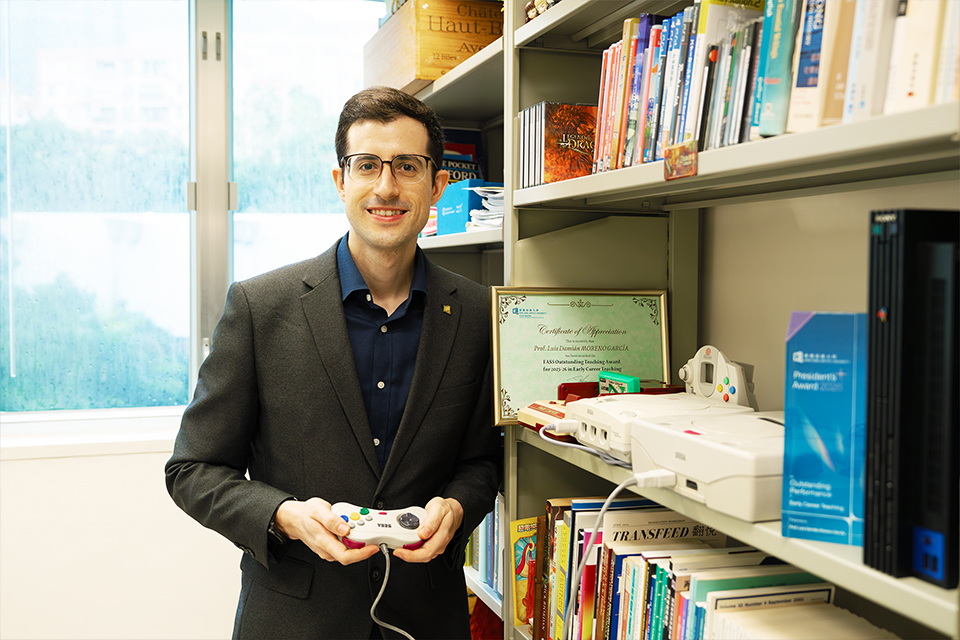
GenAI meets human language context
In Professor Moreno García’s view, much of the gaming content and artistry still come from their human creators. “We cannot lose the human touch nor can we devalue the human expertise. Players want the best experience, and the best experience is always a human experience.”
In his teaching, he plans to further develop the use of GenAI in localising gaming texts, for instance from written vernacular Chinese to the dialect of Cantonese, while ensuring the context is not getting lost in translation.
Having said that, he recognises the growing trend toward prioritising efficiency and automation in translation. While navigating this shift presents a unique challenge, he is dedicated to addressing it proactively to ensure the best outcomes for his students. “Translation is not just about choosing the right words; it’s also about remembering that you’ll make someone’s day when they finally get to play a pitch-perfect game.”