Discover HKBU
Unveiling the secrets of plants
30 Jun 2026
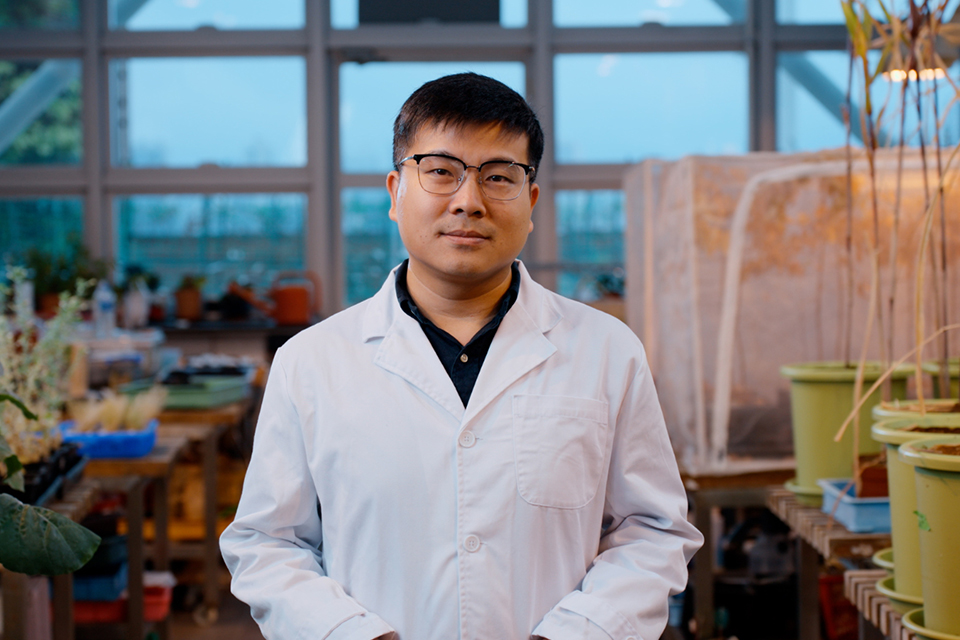
Among the tens of thousands of distinct compounds produced in plants, some contain medicinal properties while others can be used as food additives or in perfume and cosmetic products. How do we find out which compounds are beneficial to human, and how can we engineer plants to produce more high-value compounds?
These are some of the questions that pique Professor Liao Pan’s interest. Since joining HKBU in 2022, the Assistant Professor of the Department of Biology has led a team of researchers to advance knowledge in plant metabolism and biotechnology. In recent years, the team has focused on the study of volatiles, which are compounds released by plants to attract pollinators and trigger their defence mechanism such as deterring pests.
“We are interested not just in changing the profiles of the volatiles by using biotechnological techniques, but also in how we can produce more volatiles for potential applications in agriculture,” says Professor Liao. Climate change has caused shifts in the global temperature, which in turn has impacted the survival of plants and crops. A deeper understanding of volatiles and their mechanisms can facilitate the use of metabolic engineering of plants to attract more pollinators or seed dispersers, eventually facilitating the yield of plants.
The amazing potential of plants
Professor Liao’s curiosity about plants and their remarkable properties started from a young age. When he was around ten, he injured his ankle from a car accident. After months in a support frame and lingering pain, a relative suggested a herbal remedy using cactus, grounded into a paste and applied to his ankle nightly. Within days, the pain subsided.
“This experience fostered my trust in the power of plants and natural products, but I am a rational person, so I entered the research field and sought to understand the uses of medicinal plants through science,” he says.
After receiving his doctoral degree in Molecular Biology from The University of Hong Kong, Professor Liao became a postdoctoral researcher at Purdue University in the U.S., where he co-led a project which investigated bioactive compounds in thyme that contain anti-cancer properties. Since returning to Hong Kong, he has continued his research at HKBU, where he leads the only laboratory in Hong Kong that specialises in the biosynthesis, transport and biotechnology of volatile organic compounds (VOC) research.
Within a few years, Professor Liao’s research has already yielded remarkable results. In a joint study with Purdue University published in Nature Communications, he uncovered how metabolic engineering can alter VOCs from being released from plants. He has also developed a cost-effective method for producing an unusual monoterpene compound, which is commonly used in the perfume and fragrance industry. The technology won the Gold Medal with Congratulations of the Jury at the 50th International Exhibition of Inventions Geneva in 2025.
Planting the seed for future breakthroughs
Professor Liao believes Hong Kong has unique advantages for scientific research development. As an international city, Hong Kong offers opportunities for researchers to connect and communicate with collaborators from around the world. Furthermore, the Government of the Hong Kong Special Administrative Region has provided steadfast support to academic research through different funding schemes, he notes.
In addition to working with scholars from leading universities in the Chinese Mainland and from overseas, Professor Liao has teamed up with biologists from different universities in Hong Kong and with experts in other fields within HKBU on several research projects. “Collaboration is necessary,” he says. “Each lab has its unique technologies and methods. Although my collaborators and I have conducted research on different compounds, we can still learn from each other and develop new strategies for our own studies. Collaboration often creates new possibilities.”
Besides research, Professor Liao has a heart for teaching. “I'm also trying my best to train the next generation of scientists and talent. The Department of Biology at HKBU provides internships and research opportunities for undergraduate students, and some participating students have subsequently secured places in postgraduate programmes overseas at institutions such as the Johns Hopkins University, and locally at The University of Hong Kong, The Chinese University of Hong Kong, and HKBU. This way, we nurture the seed of research among our students.” He also expresses his gratitude for the strong support from the leadership and staff across HKBU, the Faculty of Science, and the Department of Biology, as well as the assistance provided by the postdoctoral fellows, postgraduate students, and research assistants on his team in carrying out the research projects. These team members have gained valuable laboratory experience, with some having secured funding from the Research Grants Council and The Hong Kong Jockey Club Charities Trust to conduct specialised research.
Professor Liao was recently honoured with the HKBU President’s Award for Outstanding Performance as Early Career Researcher this year in recognition of his scientific achievements. Looking ahead, he plans to continue his research in floral and plant volatiles, while also exploring medicinal and edible plants through synthetic biology. “My curiosity has led me to keep asking questions and delve into different topics. Research of plant metabolism and biotechnology has promising potential for applications in the agriculture, food, perfume and healthcare industries. I hope that our findings will eventually benefit our community and make people’s lives better,” he says.