Discover HKBU
Journeying from 1956 to today: Digital map shows HKBU's evolution over time
30 Oct 2026
Where was the first building of HKBU located at? What did the campus look like before the iconic Shaw Tower was completed? With the “HKBU TimeScape: Campus Development Map”, you can watch the University campus transform from 1956 to the present in just a few seconds, expanding from a single building to today’s sizable and integrated campus.
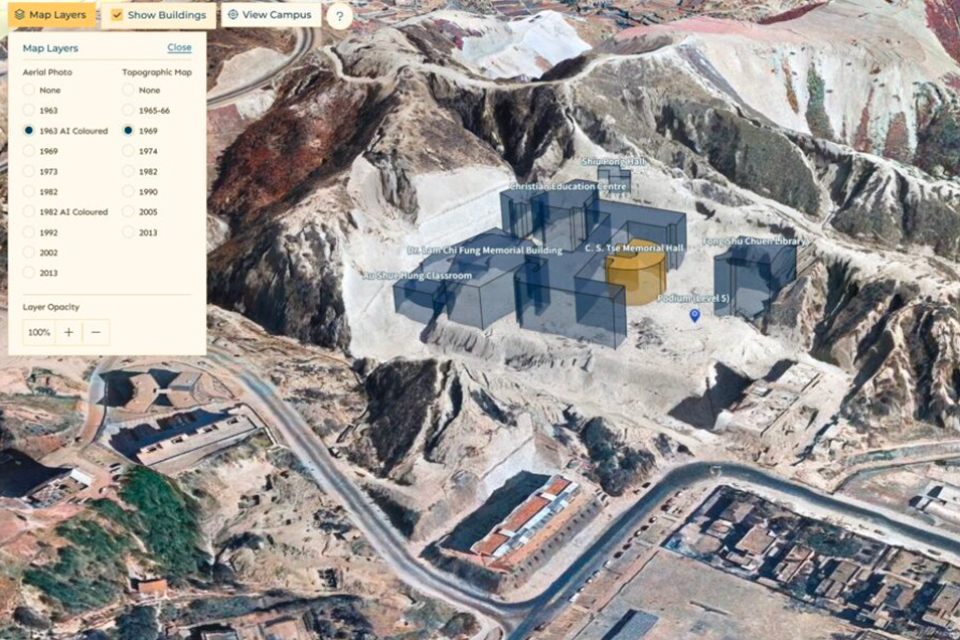
This newly launched digital platform, jointly developed by the HKBU Library and the Department of History, intertwines seven decades of the University’s history with the evolving landscape of its campus. Using the platform’s “Interactive Map”, visitors can explore the campus across different eras. They can also overlay historical aerial photographs and topographic maps to see how the campus and its surroundings have changed.
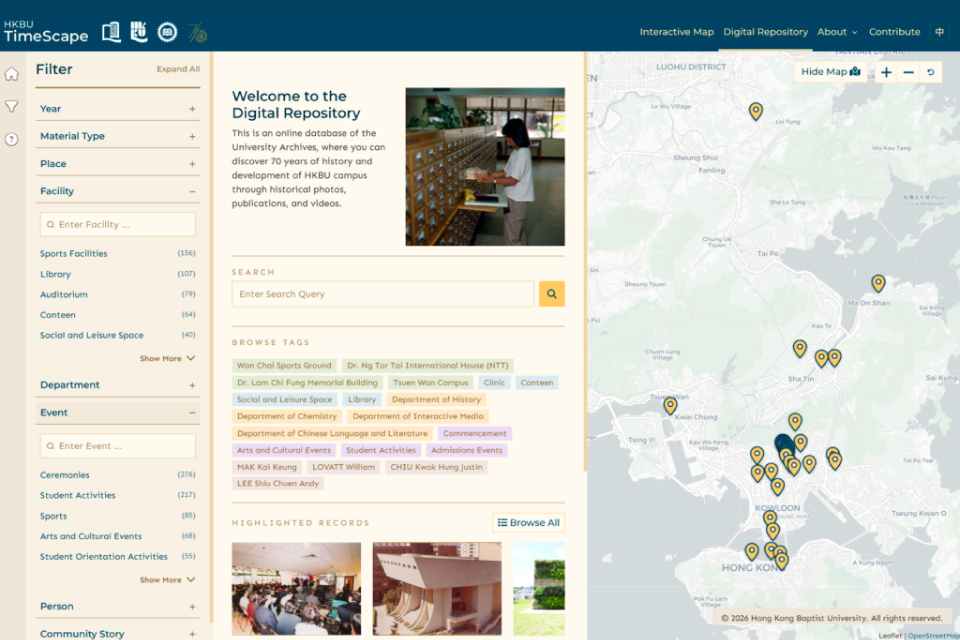
The platform also features a “Digital Repository” covering over 2,000 records, including historic photos, campus publications, videos and architectural plans, offering the University members and the public a glimpse of student life throughout the years and the stories that shaped HKBU.
Exploring 70 years of history
The platform started out as an initiative to celebrate the University’s 70th anniversary. Ms Jeannette Ma, Assistant Librarian, who curated and coordinated the project, remembers how the idea for the platform began over a casual chat at lunch. “Our team was discussing cultural mapping, campus development and spatial history. From that conversation, our vision took shape: an interactive map showcasing our campus development that utilises archives to record and share how our spaces have evolved over time,” she says.
While the Library’s Special Collections and Archives took the lead in driving the digitisation of historical archives for the project, its Systems section developed the Digital Repository, which allows cross-linking among resources, and designed a user-oriented search engine that synchronises search results in real time with location pins. “Building on our in-house technology, we developed an intuitive interface that combines interactivity and information. The integration of fast full-text search, filters, locations and pins on the map brings a unique experience,” says Mr Arthur Lee, Senior Information Technology Officer of the Library.
Transdisciplinary effort in driving digital transformation
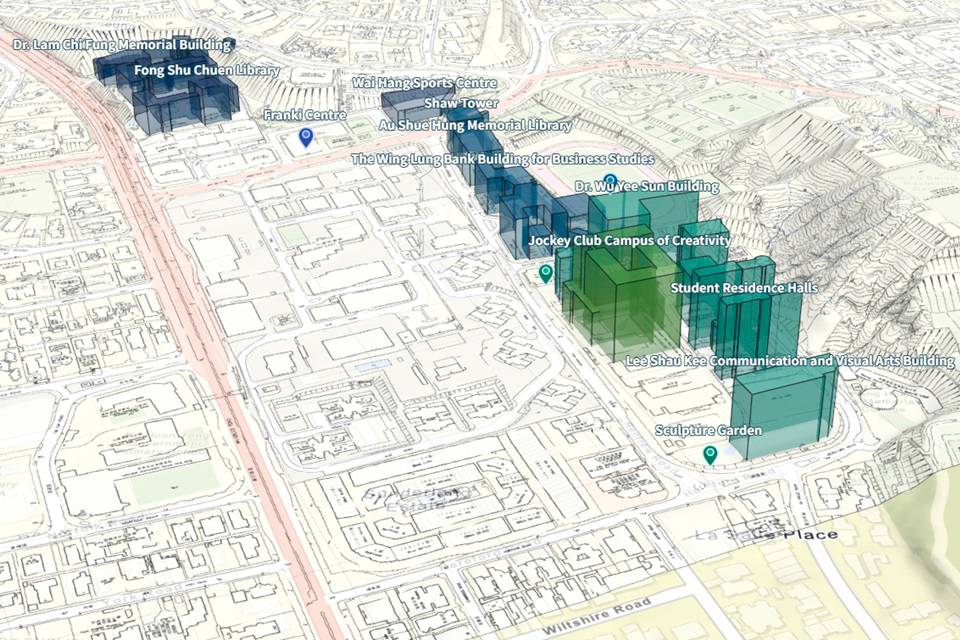
A key challenge in the development of the platform was to turn archival records into an interactive narrative. Experts from the Department of History utilised Geographic Information System (GIS), a digital tool for creating and managing geographical information, to build historical spatial datasets and 3D architectural models to depict the changes within the campus and surrounding neighbourhoods since 1956. The Library’s Digital Initiatives and Research Cluster then transformed the data into an interactive, dynamic timeline and map. Ms Yvonne So, Digital Scholarship Manager, says: “Seeing the beautiful, historically accurate 3D models come to life, supplemented by background stories and archival photos, has been a profound experience for our team.”
Applying the expertise of researching the spatial history of Hong Kong into the project, Professor Kwong Chi-man, Chair of the Department of History, and his team assembled historical maps, detailed street plans and aerial photographs of the campus. The team then georeferenced and aligned archival materials using the GIS mapping software, while ensuring spatial accuracy across decades of urban development. “Our goal was to enable layered historical visualisation, allowing users to overlay maps, images, and data across different time periods to witness the transformation of the campus landscape,” Professor Kwong says. “An innovative initiative in this project was the use of AI to colourise historical aerial photos, with reasonably good results.”


Mr Christopher Chan, University Librarian, says: “The core purpose of the HKBU TimeScape project is to make 70 years of campus history and heritage tangible to our community. With HKBU placing an emphasis on transdisciplinary collaboration, we were delighted to join hands with the Department of History. Through this partnership, we created something greater than either party could have done on their own.”
He adds that the platform is an ongoing and evolving project; the stories collected from the broader community will ensure that "HKBU TimeScape" becomes a living, ever-growing record of the University’s history.
Discover the “HKBU TimeScape: Campus Development Map”: https://digital.lib.hkbu.edu.hk/hkbutimescape